
When you want to know what the clock will show later in the day, a simple time calculation can save you from guessing. Perhaps you are planning a work shift, waiting for an important phone call, arranging an online meeting, or checking when a particular task will be finished.
Whatever the reason, knowing 15 Hours From Now helps you plan the hours ahead with a little more confidence.
Based on the reference calculation for Sunday, October 25, 2026, the starting time is 3:48:34 AM Pacific Time. Adding fifteen hours brings the clock to 6:48:34 PM on the same date.
That means the early morning turns into evening, and you can see exactly where those hours take you.
Time can feel surprisingly quick when you’re busy, but it can seem much longer when you’re waiting for something.
Understanding how to calculate future times makes everyday planning easier, whether you’re counting down to an appointment or simply curious about what time it will be later.
| Calculation | Answer |
|---|---|
| Time Duration | 15 Hours |
| Minutes | 900 Minutes |
| Seconds | 54,000 Seconds |
| Half a Day | 12 Hours |
| Extra Time | 3 Hours |
| Total Duration | 15 Hours From Now |
What Is 15 Hours From Now?
15 Hours From Now means adding fifteen complete hours to the current time. The answer depends on the starting time and time zone, so the result changes as the clock moves forward.
Using the reference time of 3:48:34 AM on Sunday, October 25, 2026, the result is 6:48:34 PM on Sunday, October 25, 2026, in Pacific Time.
Here is a quick overview of the calculation:
| Time detail | Result |
|---|---|
| Starting time | 3:48:34 AM |
| Starting date | Sunday, October 25, 2026 |
| Time interval | 15 hours |
| Future time | 6:48:34 PM |
| Future date | Sunday, October 25, 2026 |
| Time zone | Pacific Time |
| Total minutes | 900 minutes |
| Total seconds | 54,000 seconds |
| Total milliseconds | 54,000,000 milliseconds |
The important thing to remember is that the answer above uses a specific reference time. If you’re checking this article at a different moment, your own current time will produce a different result. That’s perfectly normal, and it is why a reliable time calculator can be useful.
What Time Will It Be in 15 Hours?
The answer to what time will it be in 15 hours depends on the time shown on your clock right now. You can calculate it by adding fifteen hours to your starting time and adjusting the date if the calculation crosses midnight.
For example, imagine that you check your clock at 3:48 AM. Adding twelve hours takes you to 3:48 PM. Add another three hours, and the final result is 6:48 PM.
It is a fairly straightforward calculation once you break it into smaller pieces. You don’t need advanced mathematics or a complicated formula to get it right.
Here are a few examples to help you picture the process:
- If the current time is 2:00 AM, fifteen hours later is 5:00 PM on the same day.
- If the current time is 6:00 AM, fifteen hours later is 9:00 PM on the same day.
- If the current time is 10:00 AM, fifteen hours later is 1:00 AM the following day.
- If the current time is 1:00 PM, fifteen hours later is 4:00 AM the following day.
- If the current time is 8:00 PM, fifteen hours later is 11:00 AM the following day.
Notice how the date changes when the starting time is late enough in the day. This is an important part of accurate future date and time calculations, especially when scheduling events that happen overnight.
How to Calculate 15 Hours From Now
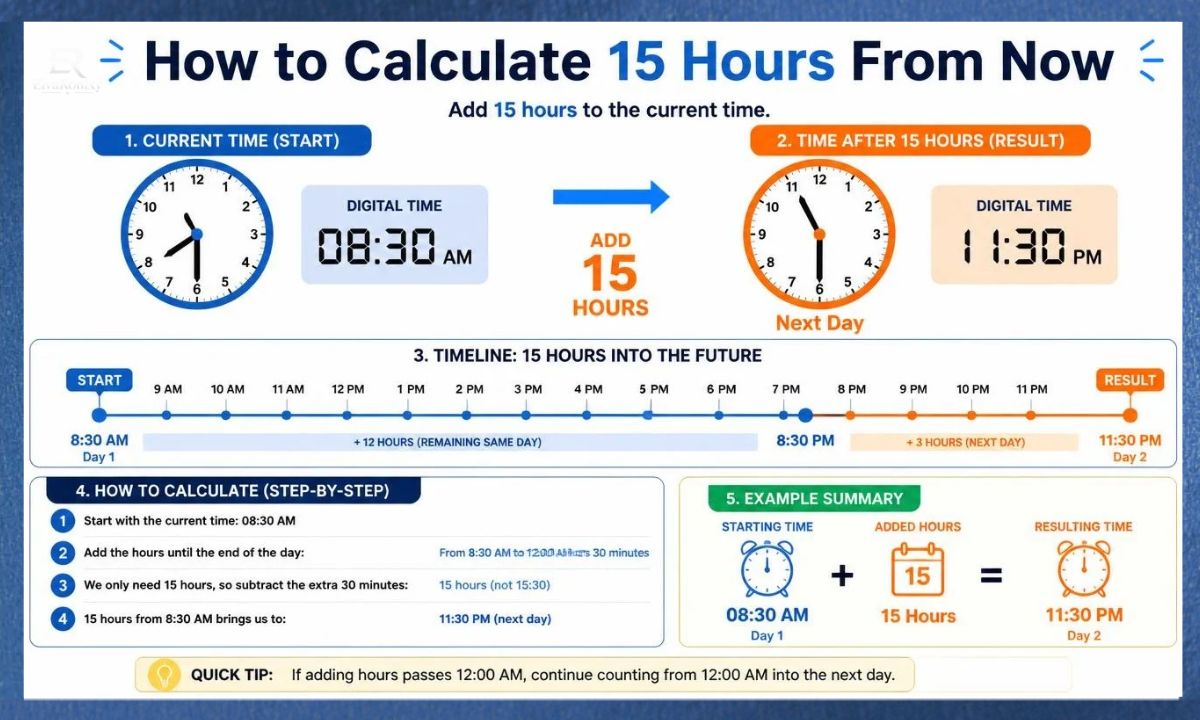
You can work out the 15 hours from current time result using a basic addition method. The trick is to consider both the hour and the minutes, rather than looking only at the hour displayed on the clock.
Suppose your starting time is 3:48 AM.
- Start with the current time: 3:48 AM.
- Add twelve hours: 3:48 PM.
- Add the remaining three hours: 6:48 PM.
- Keep the minutes unchanged because you’re adding complete hours.
- Check whether the result falls on the same date or the next day.
Your answer is 6:48 PM.
If the starting time includes seconds, those seconds remain unchanged when you add a whole number of hours. For example, adding fifteen hours to 3:48:34 AM gives 6:48:34 PM, provided the date and time-zone rules remain consistent throughout the calculation.
This simple approach works for everyday situations. However, if you’re working across different time zones or calculating a time around a daylight-saving transition, an online tool can help prevent mistakes.
15 Hours From Now in Minutes, Seconds, and Milliseconds
Hours are only one way to measure time. You can also express the same duration in minutes, seconds, and milliseconds. These conversions are especially useful for timers, software applications, scientific calculations, and digital scheduling systems.
Fifteen hours contains the following amounts of time:
| Time unit | Equivalent |
|---|---|
| Hours | 15 |
| Minutes | 900 |
| Seconds | 54,000 |
| Milliseconds | 54,000,000 |
The conversions use three simple formulas.
Hours to minutes: Multiply the number of hours by 60.
15 × 60 = 900 minutes.
Hours to seconds: Multiply the number of hours by 3,600.
15 × 3,600 = 54,000 seconds.
Hours to milliseconds: Multiply the number of hours by 3,600,000.
15 × 3,600,000 = 54,000,000 milliseconds.
The duration does not change when you express it in another unit. Only the numerical representation changes. Fifteen hours remains the same interval whether you describe it as 900 minutes or 54,000 seconds.
Why Knowing the Time 15 Hours From Now Is Useful
A future-time calculation might look like a small thing, but it can make daily routines much easier to organize. People often need to know when a long work session will end, when a reminder should appear, or how much time remains before a planned activity.
Consider someone who begins a shift early in the morning. Rather than repeatedly checking the clock and counting the hours, they can calculate the expected time in advance. That makes it easier to plan meals, transport, breaks, and other responsibilities.
Here are some practical situations where calculating fifteen hours ahead can help.
Planning Work and Study Sessions
Students and professionals often manage several responsibilities during a day. If you begin a task at a particular hour and need to check what the clock will show fifteen hours later, calculating the ending time can help you understand the full schedule.
Of course, fifteen hours is a long period to spend continuously studying or working. The calculation is useful for planning the overall interval, not a suggestion to work without taking breaks.
Managing Travel Plans
Travel often involves early departures, late arrivals, connecting journeys, and changes in local time. Adding fifteen hours to a departure time gives you a preliminary estimate of the clock time later in the journey.
However, an actual arrival time also depends on the travel duration, delays, and the time zone at the destination. A simple time difference calculator can help with time-zone comparisons, while a travel itinerary provides the relevant arrival information.
Setting Reminders and Deadlines
You might need to schedule a reminder fifteen hours after a particular event. If you know the starting time, you can calculate when the reminder should occur and enter the correct date and time into your calendar.
This can be useful for project follow-ups, routine notifications, and personal appointments. Just double-check whether your calendar uses your local time zone or another one.
Tracking Long Processes
Some household tasks, projects, and professional processes operate over several hours. Calculating a future time can help you identify when to check progress or when a planned interval ends.
For any task involving safety instructions, equipment, or time-sensitive procedures, follow the specific directions provided by the manufacturer or responsible professional rather than relying on a general time calculation alone.
Using an Online Time Calculator
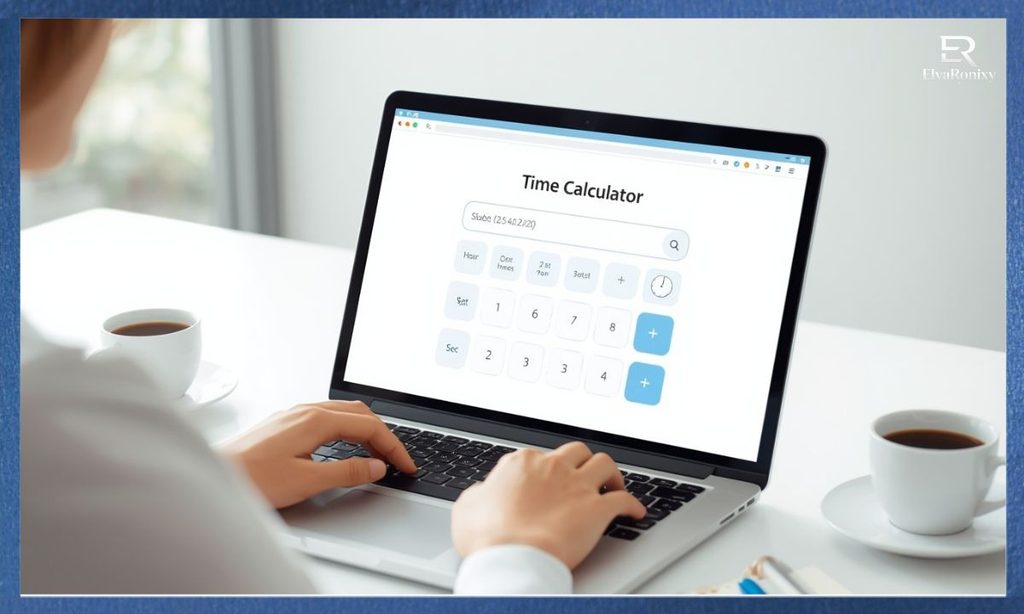
An online time calculator is one of the easiest ways to find a future clock time without doing the arithmetic manually. Most time calculators allow you to enter a starting time and specify the number of hours, minutes, or seconds you want to add.
A dedicated tool such as the Time Calculator at timer.live may be useful for exploring time calculations.
The general process is simple:
- Open a time calculator that supports adding hours.
- Enter your starting time or use the current-time option, if available.
- Enter 15 in the hours field.
- Add any extra minutes or seconds if your calculation requires them.
- Check the result, including the date and time zone.
A digital time calculator can be particularly helpful when you need an exact result rather than a rough estimate. It also reduces the risk of accidentally moving into the wrong date when your calculation crosses midnight.
Still, make sure you understand the tool’s settings. Some calculators use the device’s local time, while others may ask you to choose a time zone or enter a custom starting point.
Understanding Pacific Time in This Calculation
The reference example uses Pacific Time, a time zone observed in parts of western North America. The clock time associated with a particular moment depends on the applicable time-zone rules and the date.
For Sunday, October 25, 2026, the reference calculation starts at 3:48:34 AM Pacific Time and ends at 6:48:34 PM Pacific Time after fifteen hours.
The distinction between a time zone and a time duration matters. Fifteen hours is the length of the interval, while Pacific Time identifies the local clock system used to display the result.
If you are in Pakistan, the United Kingdom, Australia, or another location, your local clock will show a different time for the same instant. You should therefore calculate from your own starting time when planning local activities.
It is also worth distinguishing between Pacific Daylight Time and Pacific Standard Time. Daylight-saving changes can affect the relationship between local clock times and elapsed time.
If an interval crosses a clock change, adding fifteen hours to the displayed hour may not always give the correct local clock result without accounting for that transition.
For ordinary calculations that remain within a period without a time-zone change, adding fifteen hours is straightforward.
How to Add 15 Hours to Different Starting Times
A useful way to understand current time plus 15 hours is to try several starting points. These examples assume a consistent time zone and ordinary clock arithmetic.
| Starting time | Time 15 hours later | Date |
|---|---|---|
| 12:00 AM | 3:00 PM | Same day |
| 3:00 AM | 6:00 PM | Same day |
| 6:00 AM | 9:00 PM | Same day |
| 9:00 AM | 12:00 AM | Next day |
| 12:00 PM | 3:00 AM | Next day |
| 3:00 PM | 6:00 AM | Next day |
| 6:00 PM | 9:00 AM | Next day |
| 9:00 PM | 12:00 PM | Next day |
These examples use exact whole-hour starting times, so the minutes are zero in every case. If your starting time is 9:25 AM, for example, fifteen hours later is 12:25 AM on the following day.
The same principle applies to seconds. A starting time of 9:25:17 AM becomes 12:25:17 AM the following day after fifteen hours.
Once you understand the pattern, you can calculate almost any future time with a little practice.
15 Hours From Now Using the 12-Hour and 24-Hour Clock
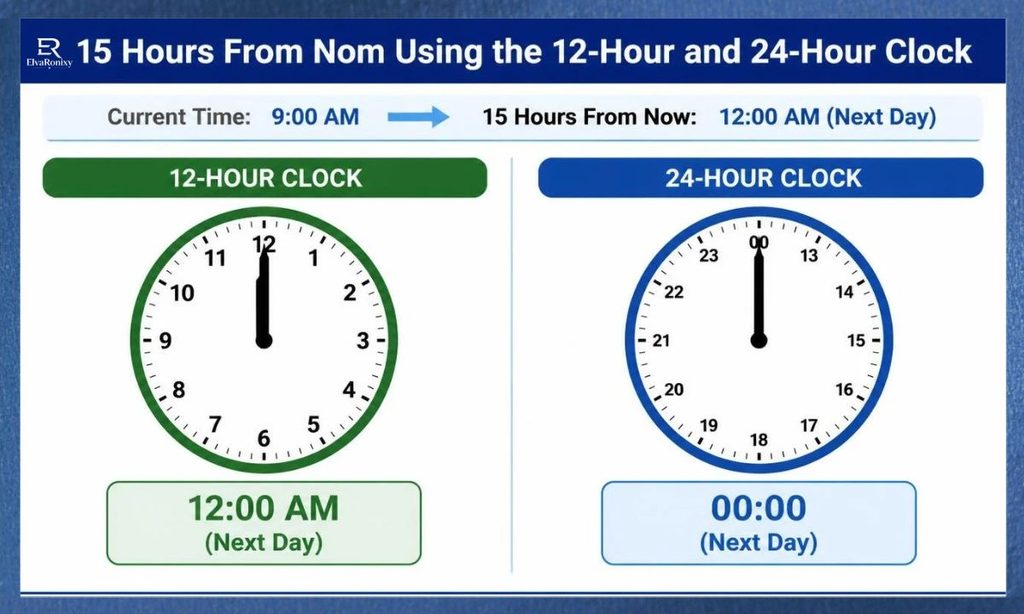
People use different clock formats depending on their location, workplace, or personal preference. The twelve-hour clock uses AM and PM, while the twenty-four-hour clock represents the day using hours from 00 through 23.
Using the reference example, the starting time of 3:48:34 AM is written as 03:48:34 in the twenty-four-hour format. Fifteen hours later, the result is 18:48:34, which is 6:48:34 PM on the twelve-hour clock.
Here is a quick comparison:
| 12-hour format | 24-hour format |
|---|---|
| 3:48:34 AM | 03:48:34 |
| 6:48:34 PM | 18:48:34 |
| 9:00 AM | 09:00 |
| 1:00 PM | 13:00 |
| 8:00 PM | 20:00 |
| 11:00 PM | 23:00 |
To convert a PM time to the twenty-four-hour format, add twelve to the hour for times from 1 PM through 11 PM. Noon remains 12:00, while midnight is represented as 00:00 at the beginning of a new day.
This format is common in transportation schedules, healthcare, aviation, and computer systems because it avoids ambiguity between morning and evening.
Common Mistakes When Calculating Future Time
Even a simple time calculation can go wrong if you overlook a few details. Most mistakes are easy to avoid once you know what to check.
Forgetting to Change the Date
If you add fifteen hours to a time such as 2:00 PM, the result is 5:00 AM on the next day, not the same day. Always check whether the calculation passes midnight.
Confusing AM and PM
A result such as 6:00 can mean morning or evening, depending on the twelve-hour clock. Include AM or PM whenever the context requires it, especially in appointments and written schedules.
Ignoring the Time Zone
If the starting time is in Pacific Time but your calendar is set to Pakistan Standard Time, the displayed local hour will differ. Make sure the time zone matches your intended location.
Rounding Away Important Details
If you need an exact result, keep the minutes and seconds from the starting time when adding a whole number of hours. For example, 3:48:34 AM plus fifteen hours is 6:48:34 PM, not simply 7:00 PM.
Using the Wrong Starting Time
A calculator can only provide a useful answer when the starting time is correct. If you enter yesterday’s time or select the wrong time zone, the result may be mathematically correct but unsuitable for your actual plans.
Frequently Asked Questions
16hrs from now
16 hours from now means adding 16 hours to the current time. The exact result depends on your current time and time zone.
15 hours from now is what time
To find the time 15 hours from now, add 15 hours to the current time. If the calculation passes midnight, the result will be on the next day.
what is 15 hours from now
15 hours from now is the future time reached by adding 15 hours to the present time. You can calculate it using a clock or time calculator.
when was 15 hours from now
“15 hours from now” refers to a future time, not a past one. If you mean 15 hours ago, subtract 15 hours from the current time.
what time is 15 hours from now
The exact time depends on when you check. Add 15 hours to your current local time to determine the result.
Read This Blog:https://elvaronixy.com/8-weeks-ago-from-today/
Final Thoughts on 15 Hours From Now
Calculating 15 Hours From Now is a practical way to understand future time, organize a schedule, and keep track of upcoming responsibilities.
Whether you’re planning a meeting, setting a reminder, checking a travel itinerary, or simply curious about the clock, the method is easy once you know the starting time.
In the reference example, 3:48:34 AM on Sunday, October 25, 2026, becomes 6:48:34 PM on the same date in Pacific Time. The fifteen-hour interval is also equivalent to 900 minutes, 54,000 seconds, and 54,000,000 milliseconds.
For quick calculations, you can add the hours manually. When accuracy across dates or time zones matters, an online time calculator can make the process more convenient.
A small calculation can make a busy day feel more organized. Keep your starting time clear, check the date, and pay attention to the time zone. With those details in place, figuring out what happens fifteen hours later becomes a simple part of planning your day.