

Have you ever looked at a calendar and wondered what the date was exactly four weeks ago? Maybe you’re checking an old appointment, calculating a project deadline, reviewing a memorable event, or simply trying to understand how quickly the days have passed.
Whatever the reason, finding a date in the past is easier than it might seem, and a simple calendar calculation can give you the answer in seconds.
As of today, Monday, October 26, 2026, 4 Weeks Ago From Today was Monday, September 28, 2026.
Four weeks is the same as 28 days, so subtracting 28 days from the current date takes you directly to September 28. It’s a small calculation, but knowing the exact date can be surprisingly useful when organizing your schedule or looking back at something important.
Think of a calendar as a collection of little time markers. Every Monday brings another weekly milestone, and moving backward by four Mondays takes you to the final Monday of September. Once you understand this pattern, calculating earlier dates becomes much less confusing.
| Calculation | Answer |
|---|---|
| Today’s Date | October 26, 2026 |
| 4 Weeks Ago | September 28, 2026 |
| Number of Weeks | 4 Weeks |
| Number of Days | 28 Days |
| Day of the Week | Monday |
What Date Was 4 Weeks Ago From Today?
The date four weeks ago was Monday, September 28, 2026. Since today’s date is Monday, October 26, 2026, moving backward exactly four weeks brings you to the same weekday in September.
Here is a quick overview of the date calculation.
| Date calculation detail | Answer |
|---|---|
| Current date | Monday, October 26, 2026 |
| Time period | 4 weeks |
| Equivalent duration | 28 days |
| Date 4 weeks ago | Monday, September 28, 2026 |
| Day of the week | Monday |
| Month | September |
| Year | 2026 |
| Week of the year | 40th week |
| Day of the year | 271st day |
| Days remaining after September 28 | 94 days |
| Year progress on September 28 | Approximately 74.25% |
These details follow the Gregorian calendar. Notice that four weeks earlier does not require changing the weekday, because four complete weeks contain exactly 28 days. If today is Monday, the date four weeks earlier will also be a Monday.
The calendar details are useful when you need more than a simple date. For example, you might need to know which week a meeting occurred in or how much of the year had passed when a particular event took place.
How to Calculate 4 Weeks Before Today
Calculating four weeks in the past is a straightforward process. You do not need a complicated formula, special software, or a wall calendar covered in notes. A little calendar math will do the job.
The simplest method is to convert weeks into days. One week contains seven days, so four weeks equal 28 days.
4 weeks × 7 days = 28 days
Next, subtract 28 days from October 26, 2026. The result is September 28, 2026.
You can also count backward one week at a time:
- One week ago: October 19, 2026
- Two weeks ago: October 12, 2026
- Three weeks ago: October 5, 2026
- Four weeks ago: September 28, 2026
This weekly method is especially handy when you are working with recurring appointments or weekly schedules. Each step moves you back seven days without changing the weekday.
If you are checking an important date for a form, deadline, or official record, it is still a good idea to verify the starting date before doing the calculation. A correct calculation based on the wrong starting date will naturally give you the wrong result, which is something worth avoiding.
Why Four Weeks Ago Is the Same as 28 Days Ago
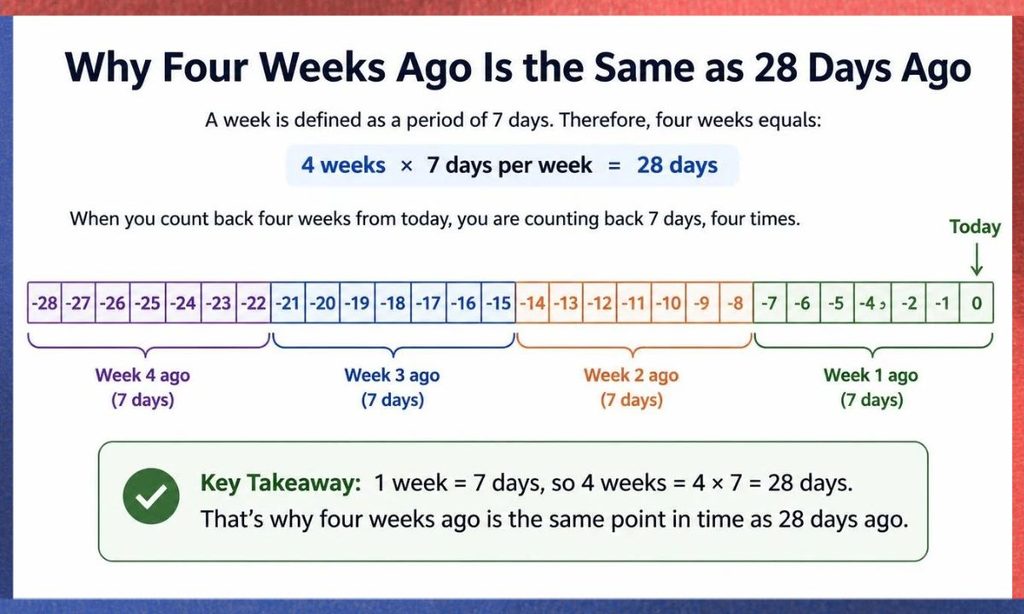
People sometimes use the expressions “four weeks ago” and “28 days ago” interchangeably. In ordinary calendar calculations, that is correct because four weeks always contain 28 days.
For example, October 26 minus 28 days equals September 28. Both methods lead to the same previous date.
However, there is a small distinction between a period of four weeks and a calendar month. A calendar month may contain 28, 29, 30, or 31 days, depending on the month and year. Four weeks always represent 28 days, regardless of the month.
Consider these examples:
- Four weeks before October 26 is September 28.
- One calendar month before October 26 is September 26.
- Four weeks before November 26 is October 29.
- One calendar month before November 26 is October 26.
The results can differ because a month is a calendar unit, while a week is a fixed seven-day period. When precision matters, use the exact duration specified in your instructions.
What Day Was It 4 Weeks Ago?
Four weeks before Monday, October 26, 2026, was Monday, September 28, 2026.
The weekday remains the same because the number of days in four weeks divides evenly into seven-day cycles. This makes weekly calculations convenient for people who schedule classes, appointments, work meetings, or other recurring activities.
Imagine that you attend a class every Monday. If you want to find the date of the class held four weeks before October 26, simply count back four Mondays. You will land on September 28.
The same principle applies to any weekday:
- Four weeks before a Tuesday is a Tuesday.
- Four weeks before a Wednesday is a Wednesday.
- Four weeks before a Thursday is a Thursday.
- Four weeks before a Friday is a Friday.
- Four weeks before a Saturday is a Saturday.
- Four weeks before a Sunday is a Sunday.
This consistency is one of the most helpful features of calendar arithmetic. Once you know the weekday of the starting date, moving backward by complete weeks preserves it.
September 28, 2026: Calendar Details Explained
September 28, 2026, has several useful calendar details beyond its position four weeks before October 26. Understanding these details can help with annual planning, historical date checks, and calculating how much of a year has passed.
The 40th Week of the Year
Under the ISO week-numbering system, September 28, 2026, falls in the 40th week of the year. ISO weeks begin on Monday, which makes this system especially convenient for weekly schedules and business planning.
The week number tells you where a date sits within the year’s sequence of weeks. It can be useful for reporting project progress, arranging production schedules, or organizing records by week rather than by month.
Be aware that not every calendar system numbers weeks identically.
Some calendars start weeks on Sunday, and different systems may assign week numbers differently around the beginning or end of a year. If a report requires a specific week-numbering convention, check which system it uses.
The Day of the Year
September 28 is the 271st day of 2026, not the 270th. The year 2026 is not a leap year, so February has 28 days.
Here is the calculation:
- January: 31 days
- February: 28 days
- March: 31 days
- April: 30 days
- May: 31 days
- June: 30 days
- July: 31 days
- August: 31 days
- September: 28 days elapsed through September 28
Adding these numbers gives 271 days. This means September 28 is day 271 of the year when January 1 is counted as day one.
Day-of-year calculations can be useful when working with annual schedules, data logs, environmental observations, or records that use sequential day numbers instead of regular calendar dates.
How Many Days Were Left in 2026?
After September 28, 2026, there are 94 days remaining in the year. This count excludes September 28 itself and includes the days from September 29 through December 31.
The calculation is simple:
- September 29–30: 2 days
- October: 31 days
- November: 30 days
- December: 31 days
Together, these add up to 94 days.
This is helpful when planning a year-end project or setting a target before January arrives. It also offers a useful reminder that the final quarter of the year can move quickly, especially when several deadlines are approaching at once.
What Percentage of 2026 Had Passed?
By September 28, 2026, approximately 74.25% of the year had elapsed, using the 271st day divided by 365 days.
The formula is:
(271 ÷ 365) × 100 = 74.25%
This calculation counts September 28 as an elapsed day. If you instead measure only fully completed days before September 28, the percentage will be slightly different. The important thing is to use one counting method consistently when comparing dates.
Year-progress calculations are often useful for personal goals, quarterly reviews, annual budgets, and long-term planning. A percentage makes the passage of time easier to compare, although it does not necessarily tell you how much work you have completed.
How a Past Date Calculator Can Help

A past date calculator is an online tool that determines an earlier date by subtracting a selected number of days, weeks, or months from a starting date. It can save time when you need to calculate several dates or work with a date that is far in the past.
For example, you might need to calculate four weeks ago for an appointment, eight weeks ago for a project review, or 90 days ago for a record check. Instead of counting manually, you can enter the starting date and choose the required time period.
A date calculator is useful for several everyday tasks:
- Checking when a previous appointment took place.
- Finding the date of a weekly meeting held several weeks earlier.
- Reviewing the start of a project or personal challenge.
- Calculating date ranges for reports and schedules.
- Finding the number of days between two dates.
- Planning recurring events or follow-up reminders.
A tool such as the Timer Live Date Calculator can help you perform these calculations online. Visit https://timer.live/date-calculator to explore date-calculation options.
Always check the starting date and selected units before relying on the result. Some tools distinguish between calendar months and fixed numbers of days, and those differences can affect the answer.
How to Calculate a Date Four Weeks in the Past Manually
You can calculate an earlier date without using an online date calculator. The method is simple enough to use with a paper calendar, a phone calendar, or even a quick written calculation.
Start by identifying the current date. In this example, it is October 26, 2026.
Next, multiply the number of weeks by seven. Four weeks multiplied by seven equals 28 days.
Then move backward 28 days on the calendar. Since October has 31 days, subtracting 26 days takes you to September 30, with two additional days to subtract. Moving back two more days gives September 28.
Another way is to subtract four weeks directly from the date because the weekday remains unchanged. October 26 minus four weeks equals September 28.
When doing longer calculations, be careful when crossing month or year boundaries. For example, calculating four weeks before January 10 may take you into December of the previous year. That is perfectly normal; the calendar simply moves across the boundary between years.
Common Reasons to Look Up a Date Four Weeks Ago
Knowing how to find a date in the past can be useful in many ordinary situations. The reason might be small, but the correct date can make a big difference when you’re organizing information or trying to remember when something happened.
Work and Project Planning
Suppose a project started four weeks before October 26. You can identify September 28 as the date to review the project’s beginning. That gives you a clear reference point for tracking milestones, completed tasks, and outstanding work.
Weekly reviews are often easier to organize when the dates fall on the same weekday. You can compare one Monday with another and see how your schedule has changed over the previous month.
Personal Events and Memories
Sometimes a date matters because of a conversation, family gathering, school event, or memorable day. Looking back four weeks can help you locate the event in your calendar or find related photographs and messages.
If you remember that something happened on a Monday, knowing that four weeks earlier was also a Monday makes the search a little easier. You may be able to narrow down the date without checking every single day.
Appointments and Follow-Ups
Medical appointments, school meetings, service visits, and other scheduled activities may require you to look back at an earlier date. A date calculation gives you a useful starting point when reviewing a diary or calendar.
For important appointments or official records, use the original confirmation or record to verify the exact date. A date calculator helps with arithmetic, but it cannot establish whether an event actually took place on that date.
Personal Goals and Habits
Four weeks can also serve as a convenient period for reviewing a new routine. Someone who began learning a skill, organizing their schedule, or keeping a daily journal can use the earlier date as a reference point.
The calculation itself is simple, yet it creates a clear boundary for reflection. You can compare what you planned four weeks ago with what you have managed to accomplish since then.
Understanding the Previous Four Weeks
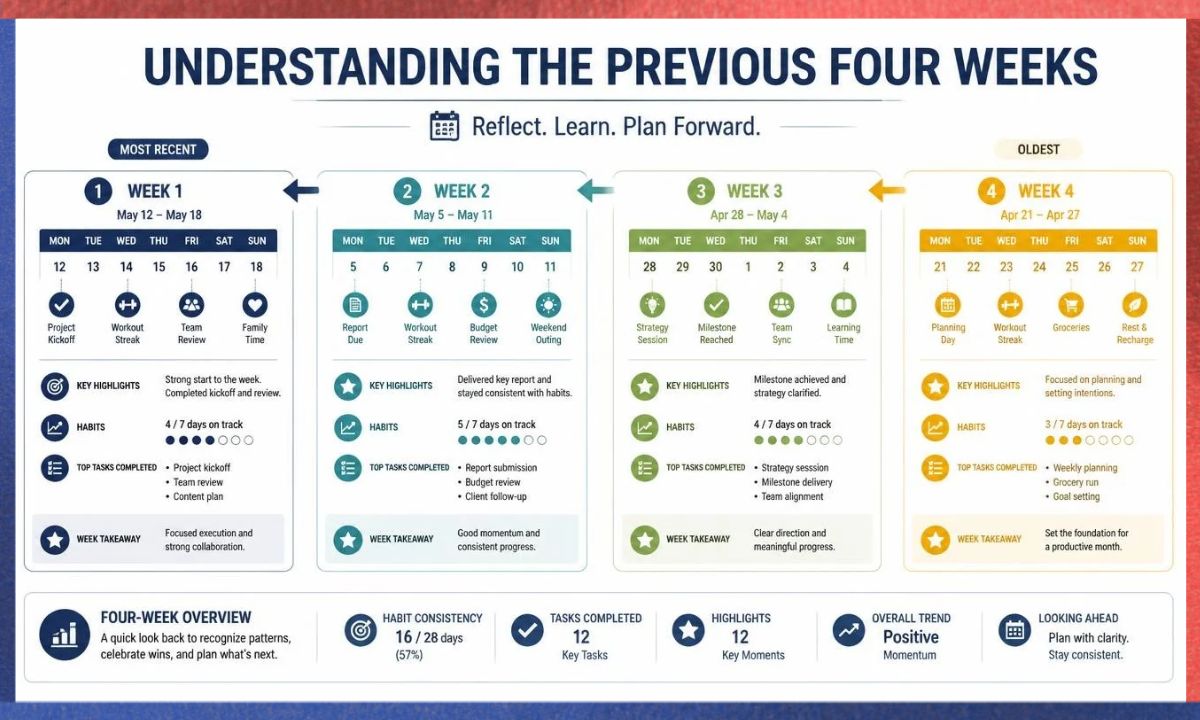
The previous four weeks leading up to October 26, 2026, cover the period from September 28 through October 26. When describing a date range, it is important to distinguish between the starting date and the full elapsed duration.
If you subtract 28 days from October 26, you arrive at September 28. The elapsed interval between these two dates is exactly 28 days.
However, if you list every calendar date including both September 28 and October 26, you will have 29 date labels. That does not mean the interval is 29 days; it means both endpoints have been included in the list.
This distinction can be important when filling out forms, calculating attendance, or counting days for a deadline. Some systems count both the first and last dates, while others count only the elapsed time between them.
When the instructions are unclear, check whether the calculation requires an inclusive date count or the actual number of elapsed days.
Past Date Calculator vs. Calendar Month Calculation
A date calculator can handle several different types of date arithmetic, but not every date-related question means the same thing.
Subtracting four weeks means subtracting 28 days. Subtracting one month means moving to the equivalent calendar date in the previous month, where possible.
For example:
| Starting date | Calculation | Result |
|---|---|---|
| October 26, 2026 | 4 weeks earlier | September 28, 2026 |
| October 26, 2026 | 28 days earlier | September 28, 2026 |
| October 26, 2026 | 1 calendar month earlier | September 26, 2026 |
| October 26, 2026 | 2 weeks earlier | October 12, 2026 |
| October 26, 2026 | 6 weeks earlier | September 14, 2026 |
These examples show why it helps to understand the wording of a date-related request. A four-week period is a fixed 28-day interval, while a calendar month depends on the lengths of the months involved.
If you are working with a custom date calculation, make sure the tool is set to the correct unit. That small check can prevent confusion later.
How to Make Date Calculations More Useful
The best way to use a date calculator is to begin with a clear question. Are you trying to find the date 28 days ago, identify a previous Monday, calculate a deadline, or compare two calendar dates? Knowing exactly what you need makes the process much easier.
For recurring tasks, write down the starting date and the result so you can refer to them later. A digital calendar can also help you record reminders and keep track of weekly events without having to repeat the calculation.
If you need to calculate several dates, use a consistent method each time. Subtracting a fixed number of days works well for precise intervals, while calendar-month calculations are more suitable when the instruction specifically refers to a month.
Finally, double-check dates that cross month or year boundaries. These are the situations in which small arithmetic mistakes are most likely to occur, particularly when you are working quickly.
Frequently Asked Questions
What Date Was 4 Weeks Ago From Today?
Four weeks ago from October 26, 2026, was September 28, 2026.
What Day Was It 4 Weeks Ago?
Four weeks ago was Monday, September 28, 2026.
How Many Days Are in 4 Weeks?
There are 28 days in four weeks, as each week contains seven days.
What Date Was 4 Weeks Ago From Yesterday?
Four weeks ago from yesterday, October 25, 2026, was September 27, 2026.
How Can I Calculate 4 Weeks Ago From Today?
Subtract 28 days from today’s date to find the exact date four weeks ago.
Read This Blog:https://elvaronixy.com/15-hours-from-now/
Conclusion
Finding 4 Weeks Ago From Today is a simple calendar calculation once you know the starting date. On Monday, October 26, 2026, the date four weeks earlier was Monday, September 28, 2026. Four weeks equal 28 days, and subtracting those days gives the exact previous date.
September 28 also falls in the 40th week of 2026 under the ISO system and is the 271st day of the year. There were 94 days remaining after that date, and approximately 74.25% of the year had elapsed.
Whether you are checking an appointment, reviewing an earlier event, planning a project, or simply satisfying your curiosity, understanding date calculation can save time and prevent confusion. A calendar or online date calculator makes the task even easier.
Keep the basic rule in mind: multiply the number of weeks by seven, then subtract that many days from your starting date. With this simple approach, finding a date four weeks ago or several weeks further back becomes a quick and reliable part of everyday planning.