
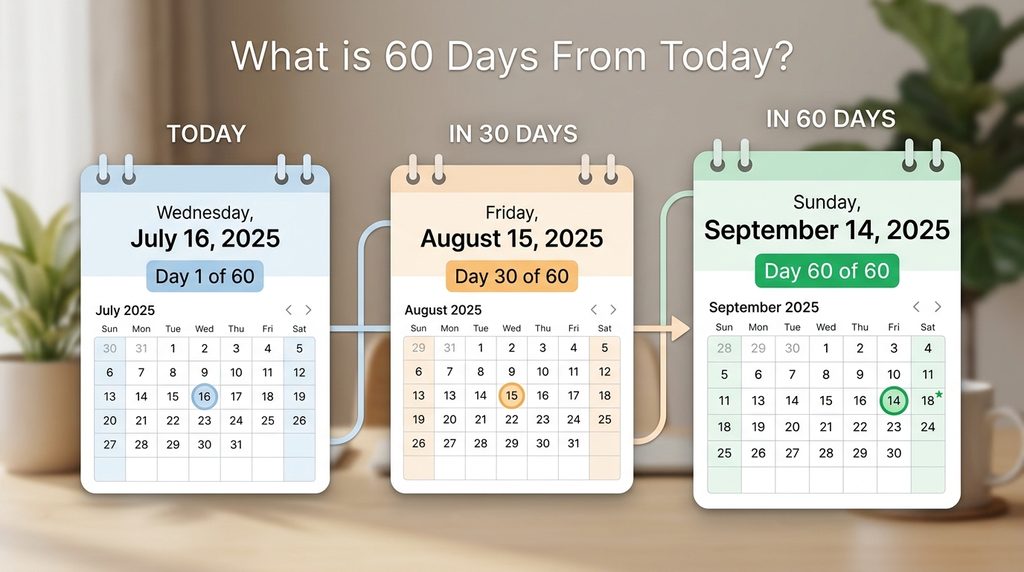
There is something oddly comforting about looking at a calendar and asking a very simple question: What is 60 days from today? Sixty days sounds like a long stretch when you say it out loud, but on a calendar it moves surprisingly quick.
One minute you are thinking about today’s plans, and then suddenly you are staring at a date nearly two months away, wondering where all those little days disappeared to.
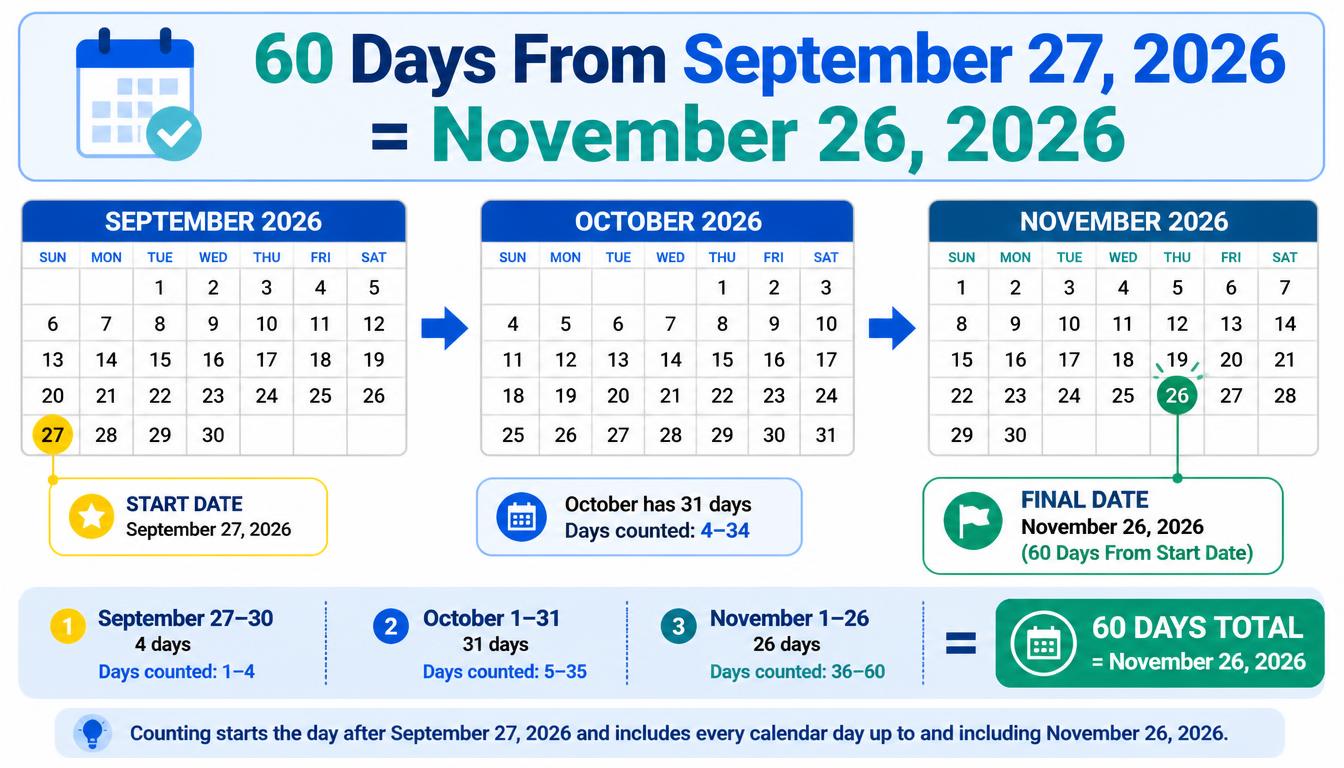
If today’s date is September 27, 2026, then the date 60 days from today is November 26, 2026. That means November 26 will arrive after a complete 60-day interval has passed.
It is a useful date to know for appointments, school schedules, project deadlines, celebrations, travel plans, reminders, or simply for satisfying that little calendar curiosity we all get sometimes.
A 60 days from today calculator makes this calculation almost effortless. Instead of counting every square on a calendar and accidentally losing track somewhere around the middle, you can use a date calculator to find the exact future date in seconds.
Still, understanding how the calculation works is useful too, specially when you need to check an answer yourself.
| Question | Answer |
|---|---|
| Today | September 27, 2026 |
| 60 Days From Today | November 26, 2026 |
| Day | Thursday |
| 60 Days Ago | July 29, 2026 |
What Is 60 Days From Today?
Starting with September 27, 2026, we count forward 60 individual days. September has 30 days, so there are 3 days remaining after September 27 if we begin counting the following day: September 28, 29, and 30.
Then October contributes 31 days. After those 34 days have passed, we still need another 26 days. Counting 26 days into November brings us to November 26, 2026.
So, the direct answer is:
September 27, 2026 + 60 days = November 26, 2026
If you’re searching what date is 60 days from today, what date is 60 days after September 27 2026, or what date will it be 60 days from September 27 2026, they all lead to the same calendar result: November 26, 2026.
It is a tiny bit magical how a simple number can turn into an actual day on the calendar.
60 Days From Today: November 26, 2026
The exact 60 Days From Today date is November 26, 2026. This is the future date produced by adding 60 days to September 27, 2026.
November 26, 2026 falls on a Thursday. So if you were wondering what day will it be 60 days from today, the answer is Thursday.
This can be useful when planning something that needs more than a month of preparation but less than a full season. Sixty days gives enough breathing room for many ordinary plans, without making the deadline feel like it belongs to another lifetime.
For example, you might use this date for:
- A project deadline
- A study or revision target
- A travel plan
- A family event
- A payment reminder
- A personal goal
- A school activity
- A work milestone
- A subscription or renewal reminder
- A future appointment
Sometimes knowing the exact date is all you need. Other times, seeing the number of weeks and months makes the interval easier to understand.
How to Calculate 60 Days From Today
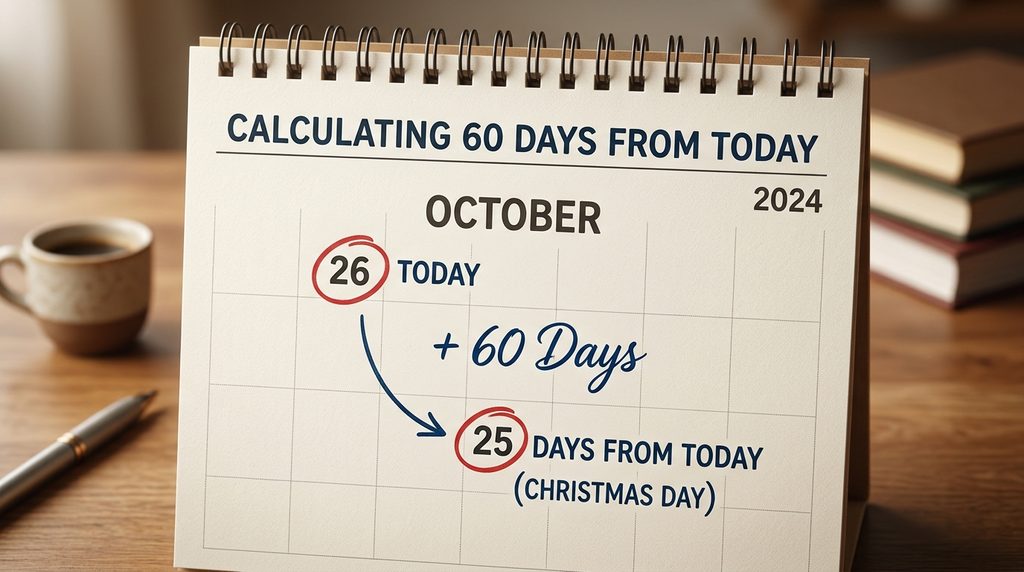
You don’t actually need a complicated formula to calculate 60 days from today. A normal calendar can do the job, although it can become slightly annoying if you’re counting by hand and your brain suddenly decides that October has 32 days.
Start with September 27, 2026.
September has 30 days, so the first three days counted forward are September 28, September 29, and September 30. That gives us 3 days.
October contains 31 days. Add those to the first 3 days and you have:
3 + 31 = 34 days
Now we need:
60 34 = 26 days
The 26th day of November is therefore the final destination.
So the date 60 days from today is November 26, 2026.
This method is a simple form of date arithmetic, where you add or subtract a specified number of days from a starting calendar date.
Using a 60 Days From Today Calculator
A 60 days from today calculator is especially handy when you need an exact answer quickly. You enter the starting date, choose the number of days, and the tool calculates the resulting date without requiring you to stare at a calendar for five minutes.
A typical Simple Date Calculator may allow you to:
- Add days to a date
- Subtract days from a date
- Add weeks to a date
- Subtract weeks from a date
- Add months to a date
- Subtract months from a date
- Find a future date
- Compare relative dates
- Calculate a date range
- Explore different date intervals
Some tools also include a reset option, which sounds very ordinary until you enter several dates and realize you have created a tiny mathematical jungle.
A future date calculator is useful because it handles month lengths automatically. This matters because months don’t all contain the same number of days, and February is particularly fond of making date calculations more interesting than they need to be.
60 Days From Today in Weeks and Months
Sixty days can also be expressed using weeks and months, although these aren’t perfectly interchangeable units.
There are 7 days in one week, so:
60 ÷ 7 = 8 weeks and 4 days
Therefore, 60 days equals 8 weeks and 4 days.
In terms of months, the answer is approximately two months, but it isn’t exactly two calendar months. September 27 to November 27 would be two calendar months, while November 26 is one day earlier.
This distinction is important when dealing with date intervals. A request for “two months from today” isn’t necessarily identical to a request for “60 days from today.”
That’s why a proper date interval calculator can be more useful than simply estimating based on the number of months.
What Date Is 60 Days From September 27, 2026?
If your starting point is specifically September 27, 2026, then the calculation is straightforward.
September 27, 2026 + 60 days = November 26, 2026
So the answer to calculate 60 days from September 27 2026 is November 26, 2026.
The same answer applies to searches such as 60 days from now, date 60 days ahead, 60 days ahead from today, and 60 days later, provided the starting date is September 27, 2026.
One small detail matters here: relative dates depend on the starting day. If you read this article on another date, the result will naturally be different. That’s the slightly slippery nature of the phrase “from today.”
30, 60, 90, 120, and 150 Days From Today
People often compare several intervals when planning future dates. A date calculator from today can make this much easier.
For the starting date of September 27, 2026:
- 30 days from today: October 27, 2026
- 60 days from today: November 26, 2026
- 90 days from today: December 26, 2026
- 120 days from today: January 25, 2027
- 150 days from today: February 24, 2027
These intervals create a useful little timeline stretching from early autumn into the following winter. It also shows why calculating dates manually can become tiresome once several intervals are involved.
You can use a days ahead calculator to explore these dates, or a days ago calculator if you want to move backward instead. The same basic idea works in both directions, just with different calendar arithmetic.
What About 60 Days Ago?
The opposite of 60 days ahead is, naturally, 60 days ago.
If today is September 27, 2026, moving backward by 60 days takes you to July 29, 2026.
That gives us an easy comparison:
- 60 days ago: July 29, 2026
- Today: September 27, 2026
- 60 days ahead: November 26, 2026
Thinking about relative dates this way can make calendar planning much clearer. Instead of seeing a date as an isolated number, you can understand it as a point within a larger relative date range.
Other Useful Date Intervals

A good date tool isn’t only useful for 60 days. You might want to calculate 10 days, 45 days, 100 days, or an entirely different interval.
For example, common date calculations include:
- 30 days for roughly one month of planning
- 60 days for a two-month-ish interval
- 90 days for a quarterly planning period
- 120 days for a longer-term milestone
- 150 days for a five-month-ish period
You can also use a calculator to subtract days from a date, add weeks to a date, or subtract months from a date. The possibilities are pretty much as wide as the calendar itself.
For people organizing projects, these calculations can help establish deadlines and milestones without relying on memory, which, lets be honest, sometimes has its own calendar and refuses to share it.
Understanding Relative Dates
The phrase relative dates means dates described in relation to another date. “Tomorrow,” “30 days from now,” “60 days ago,” and “three weeks from today” are all examples.
Unlike a fixed date such as November 26, 2026, a relative date changes whenever the reference date changes.
If today were September 27, then 60 days ahead is November 26. But if today were October 1, 60 days ahead would obviously be different.
This is why a relative date calculator normally needs two pieces of information: the starting date and the interval. Once those are known, the date calculation becomes much less mysterious.
A Quick Look at Historical Dates Around This Time
Calendars aren’t just tools for planning the future. They also preserve remarkable historical moments.
October and November contain plenty of important dates in history. On October 12, 1492, Christopher Columbus reached islands in the Caribbean during his first voyage across the Atlantic.
The event became a major turning point in European exploration and was followed by enormous and often devastating consequences for Indigenous peoples, including colonization and the Columbian Exchange.
On October 14, 1962, U.S. officials received photographic evidence connected to Soviet nuclear missile sites in Cuba, beginning the period now known as the Cuban Missile Crisis.
The confrontation between the United States and Soviet Union brought the world dangerously close to nuclear conflict.
Another important date is October 29, 1929, associated with the dramatic Wall Street crash commonly called Black Tuesday. The wider economic crisis contributed to the Great Depression, affecting communities far beyond the stock market itself.
Then comes November 9, 1989, when the Berlin Wall began opening, becoming one of the defining moments associated with the end of the Cold War and the eventual reunification of Germany.
History also gives us November 21, 1620, when the Mayflower Compact was signed aboard the Mayflower near Cape Cod.
It became an important early example of colonial self government, though the broader colonial story also includes profound consequences for Indigenous peoples.
And November 22, 1963, marks the assassination of John F. Kennedy in Dealey Plaza in Dallas, Texas. Vice President Lyndon B. Johnson became president later that day.
These historical events remind us that a calendar date is never just a number. A single square on the calendar can contain an ordinary Thursday for one person and a world-changing event for someone else, which is kinda beautiful and unsettling at the same time.
Why Exact Dates Matter
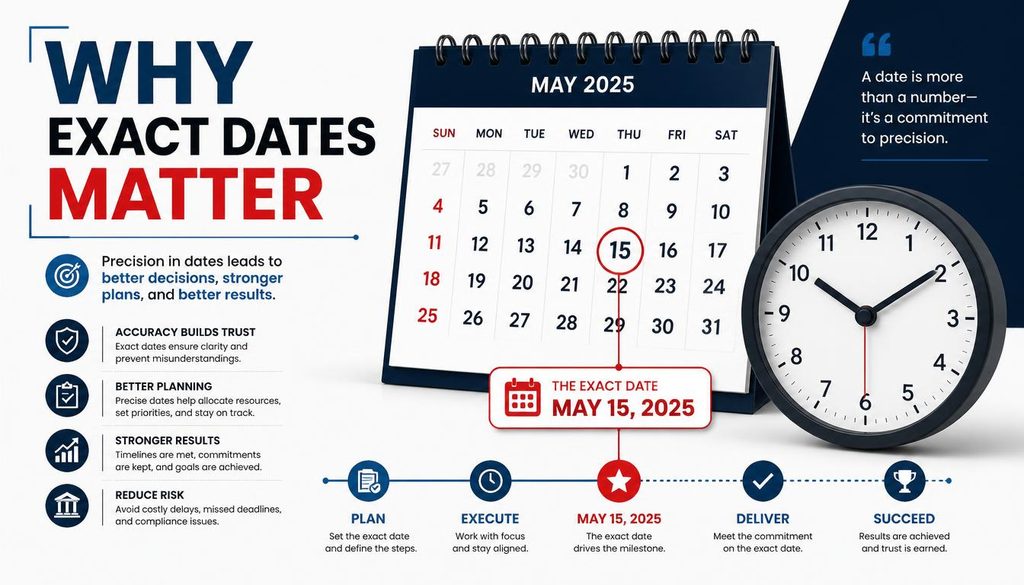
Knowing an exact date 60 days from today can prevent misunderstandings. Saying “about two months from now” leaves room for interpretation, while saying “November 26, 2026” gives everyone the same destination.
This is especially helpful for appointments, contracts, school schedules, travel arrangements, deadlines, and family plans.
An exact calendar date also makes reminders easier to set. Rather than remembering an abstract time interval, you can write the date down and move on with your day.
It may sound like a tiny thing, but tiny things are often what keep larger plans from becoming messy.
How to Use a Date Calculator Correctly
When using an online date calculator, first check the starting date. If you’re calculating from today, make sure the tool is actually using your current local today rather than a previously selected date.
Next, choose whether you want to add or subtract. For this calculation, select the option to add days and enter 60.
Then verify the result. A reliable date widget should show the resulting date clearly, allowing you to compare it with your own calendar if needed.
For more complicated planning, try several intervals. You might calculate 30 days, 60 days, and 90 days to create a simple future date range.
The trick is not really the mathematics. It’s making sure the starting date and counting method are correct.
Common Questions About 60 Days From Today
What is 60 days from today?
If today is September 27, 2026, then 60 days from today is November 26, 2026. The date is reached by adding 60 calendar days to September 27.
What date is 60 days from today?
The date 60 days from today is November 26, 2026, when September 27, 2026 is used as today’s date.
What day will it be 60 days from today?
Sixty days from September 27, 2026 will be Thursday, November 26, 2026. So the answer includes both the calendar date and weekday.
How many days until November 26, 2026?
From September 27, 2026, there are 60 days until November 26, 2026. This is a straightforward 60-day calendar interval.
What is the date 60 days after September 27 2026?
The date 60 days after September 27, 2026 is November 26, 2026. You can confirm it with a 60 day date calculator or by counting through the calendar.
Is 60 days the same as two months?
Not exactly. Sixty days is a fixed number of days, while two calendar months can contain different numbers of days depending on the months involved.
Can I calculate dates in the past too?
Yes. A date calculator can generally move either direction. You can add days to a date for future dates or subtract days from a date to find past dates.
Making Date Calculations Easier
If you regularly need to calculate future dates by days, it helps to keep a simple system. Write down the starting date, the number of days you want to move, and the resulting date.
For example:
Starting date: September 27, 2026
Interval: 60 days
Result: November 26, 2026
For larger plans, you can create a small list of upcoming dates. This is useful for projects where several milestones are separated by 30-day or 60-day intervals.
A date interval calculator is particularly useful when you need precision. It takes away the annoying part of manually counting calendar squares, while still leaving you in control of the plan.
Frequently Asked Questions
60 days from today is what date
60 days from today falls on November 26, 2026. Use a date calculator to confirm the exact date based on your current date.
60 days from today date
The date 60 days from today is November 26, 2026, counting forward 60 calendar days.
whats 60 days from today
60 days from today is November 26, 2026. This is the date you get by adding 60 days to September 27, 2026.
what was 60 days ago
60 days ago was July 29, 2026. This date is calculated by counting back 60 calendar days from September 27, 2026.
when was 60 days ago
60 days ago was July 29, 2026. It was exactly 60 calendar days before September 27, 2026.
Read this Blog:https://elvaronixy.com/tools-weeks-16/
Final Thoughts on 60 Days From Today
So, what is 60 days from today? With September 27, 2026 as today’s date, the answer is November 26, 2026.
That gives us a neat little journey of 60 days, moving from late September through October and into the final stretch of November.
Along the way, the calendar quietly passes through ordinary mornings, busy afternoons, unexpected conversations, weekends, celebrations, and probably a few days when nobody remembers what day it even is.
A 60 days from today calculator is convenient, but understanding the calculation is valuable too. Once you know how to calculate date intervals, you can work with 30 days, 60 days, 90 days, or almost any other period without feeling lost among the numbers.
And perhaps that’s the nicest thing about dates: they give shape to time. A future date isn’t just somewhere “later.” It is a real square on a calendar, waiting quietly for us to reach it.
If you’re planning something for November 26, 2026, write it down now. Add a reminder, mark your calendar, tell the people who need to know, and then let the next 60 days unfold naturally.
Time has a habit of arriving whether we’re perfectly ready or not, so we might as well give it a proper date.