

Have you ever looked at a calendar and wondered where the next few months will take you? Perhaps you’re planning a family gathering, setting a personal goal, preparing for an important appointment, or simply curious about a date that seems far away.
Whatever the reason, knowing the future date can make planning feel a little less confusing. Sometimes, all you need is a simple calculation to turn a vague idea into a clear plan.
If you’re searching for 20 Weeks From Today, the answer is Thursday, March 4, 2027, when counting forward from October 15, 2026. That might seem like a long stretch of time, but it passes through the calendar one ordinary day at a time.
Before you know it, winter will be underway, a new year will have begun, and March will be waiting just around the corner.
Twenty weeks can be a useful planning period for school projects, personal milestones, travel preparations, work schedules, and long-term goals.
It is long enough to make meaningful progress, yet close enough to imagine what life might look like when the date arrives. And honestly, having an exact date written down makes the whole thing feel more manageable.
| Calculation | Result |
|---|---|
| Today’s Date | October 15, 2026 |
| 20 Weeks From Today | March 4, 2027 |
| Number of Weeks | 20 Weeks |
| Total Days | 140 Days |
| Day of the Week | Thursday |
| 20 Weeks Ago | May 28, 2026 |
What Is 20 Weeks From Today?
The date 20 weeks from today is Thursday, March 4, 2027. This calculation uses October 15, 2026, as the starting date and adds 20 complete weeks to the calendar.
Here is a quick overview of the result.
| Date calculation detail | Answer |
|---|---|
| Today’s date | Thursday, October 15, 2026 |
| Number of weeks | 20 weeks |
| Total number of days | 140 days |
| Future calendar date | March 4, 2027 |
| Day of the week | Thursday |
| Year | 2027 |
| Week number | ISO week 9 |
| Day of the year | 63rd day |
| Days remaining in 2027 after March 4 | 302 days |
| Calendar system | Gregorian calendar |
The most important detail is that adding 20 weeks means adding 140 days, not counting today as the first day of the period. This distinction can make a difference when you’re planning a deadline or checking a date with an online Date calculator.
For example, if you start on Thursday, October 15, 2026, each complete week brings you back to Thursday.
After 20 complete weeks, the final date is Thursday, March 4, 2027. It’s a straightforward calculation, but it’s surprisingly easy to lose track when counting manually across different months.
20 Weeks From Today on the Calendar
When you look at a calendar, 20 weeks might appear to cover a huge number of squares. In reality, the calculation follows a simple pattern: seven days make one week, and 20 weeks contain 140 days.
The journey from October to March crosses several different months, including the end of 2026 and the beginning of 2027. This is why adding weeks can sometimes be easier than trying to estimate the date by adding months.
Here is how the calendar period unfolds:
- October 15, 2026: The starting date.
- November 2026: The first full month you move through after the starting point.
- December 2026: The year approaches its final days.
- January 2027: A new calendar year begins.
- February 2027: The year continues into its second month.
- March 4, 2027: The final date, exactly 20 weeks later.
A calendar is a bit like a long road with familiar signposts. Each month is another landmark, and the weeks help you measure how far you’ve travelled. If you’re making plans, marking March 4 on your calendar now can help you keep the date in sight without repeatedly counting the days.
How to Calculate 20 Weeks From Today
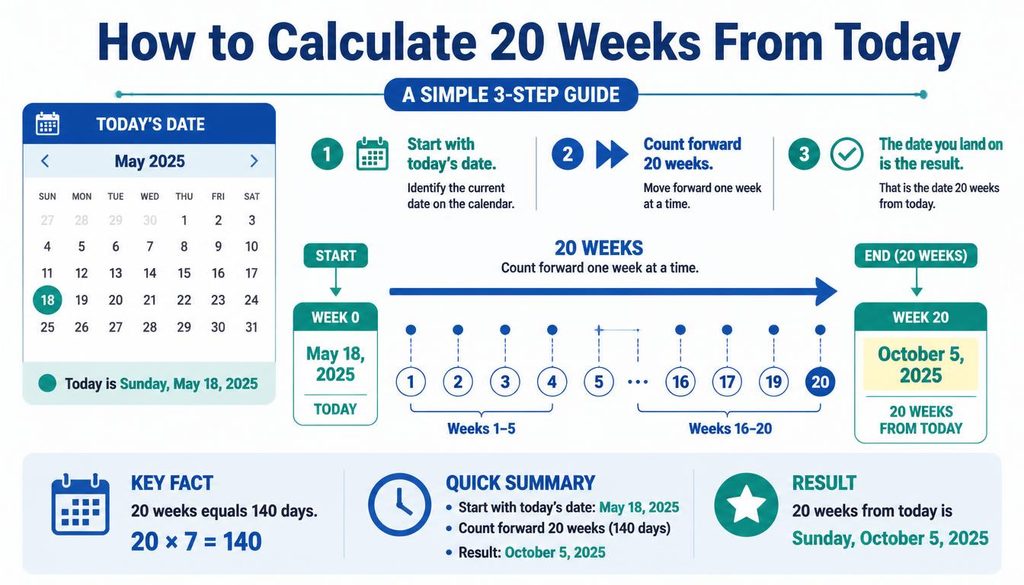
You don’t need a complicated formula to calculate a future date. A little multiplication and a calendar are enough, although a Future date calculator can make the process faster when you’re checking several dates.
Step 1: Convert Weeks Into Days
Every standard calendar week contains seven days.
To find the total number of days in 20 weeks, multiply the number of weeks by seven.
20 × 7 = 140 days
Therefore, 20 weeks equals 140 days. This weeks-to-days conversion is the foundation of the calculation.
Step 2: Start With the Correct Date
The starting date for this example is October 15, 2026. Always check the current date before calculating, because the result changes as the days pass.
If you use a different starting date, you’ll get a different future date, even when the number of weeks stays the same.
Step 3: Add 140 Days
Move forward 140 days from October 15, 2026. You can do this by counting through the remaining days of October, then November, December, January, February, and finally March.
The resulting date is March 4, 2027.
Step 4: Verify the Weekday
A useful way to double-check your result is to look at the weekday. Because 140 is divisible by seven, adding 140 days preserves the starting weekday.
October 15, 2026, is a Thursday, so March 4, 2027, is also a Thursday.
This little verification trick is handy whenever you need to calculate future dates without accidentally shifting the result by a day.
Why Use a Date Calculator?
A Date calculator is a practical tool for finding future dates, checking past dates, and working out the time between two calendar days. Rather than counting every square on a calendar, you enter a starting date and choose the number of days or weeks you want to add.
A good calculator is especially useful when the period crosses several months or a year boundary. Human brains are pretty good at remembering birthdays and appointments, but manually counting 140 days is a different story.
Here are a few reasons to use a date calculation tool:
- Speed: Get a future date without counting every day yourself.
- Accuracy: Reduce mistakes when moving between months of different lengths.
- Flexibility: Add or subtract weeks, days, or other supported time periods.
- Planning: Identify deadlines, appointments, events, and milestones.
- Verification: Check a date you calculated manually.
Some online tools, including Timer.live, offer time-related calculations that can help users explore dates and periods. When using any online Future date finder, confirm that the starting date and selected time period are correct before relying on the result.
It’s also worth remembering that a date calculator and a time calculator are not always the same thing. A date-only calculation typically adds calendar days, while a date-and-time calculation may also consider the time of day and time zone.
What Day of the Week Is March 4, 2027?
March 4, 2027, falls on a Thursday.
Knowing the weekday can be just as useful as knowing the date itself. If you’re scheduling a meeting, arranging a delivery, planning a school activity, or setting a personal deadline, the weekday helps you decide what needs to happen around it.
Thursday is a weekday, which means it falls between Wednesday and Friday. It is not a Saturday or Sunday, so people who follow a conventional Monday-to-Friday working schedule may find that distinction useful.
For instance, imagine you want to finish a project by March 4. You can work backwards to establish smaller milestones, perhaps completing research in January and reviewing your progress in February.
Instead of treating the deadline as one distant point, you can build a realistic schedule around it.
Always check local public holidays and organizational schedules as well. A date can fall on a regular weekday and still be affected by a holiday, school break, or special event.
What Week of the Year Is March 4, 2027?
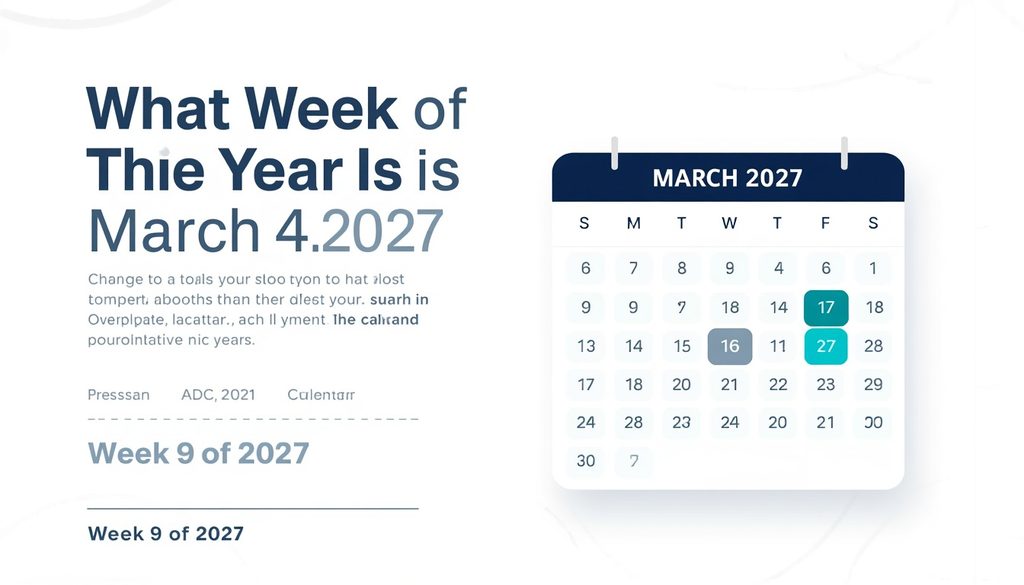
March 4, 2027, falls in ISO week 9, using the international week-numbering standard.
Week numbers are useful when you want to describe a period without repeatedly writing the full date. For example, a project schedule might refer to week 9 of 2027, while a company may organize its reporting by calendar weeks.
The ISO week-numbering system treats Monday as the first day of the week. Its first week is the week containing the year’s first Thursday. Under this system, March 4, 2027, belongs to week 9.
Not every calendar or organization uses the same convention, however. Some systems start the week on Sunday, and some count the first partial week differently. If you are comparing calendars, make sure you are using the same week of the year standard.
That small detail can prevent confusion in business reports, academic timetables, and project plans.
What Day of the Year Is March 4, 2027?
March 4, 2027, is the 63rd day of the year.
The year 2027 is not a leap year, so it has 365 days. January contributes 31 days, February contributes 28, and the first four days of March add another four days.
The calculation is:
31 + 28 + 4 = 63
This means March 4 is day 63 in the Gregorian calendar’s annual sequence.
Day-of-year numbers are often used in technical schedules, data records, scientific work, and systems that need a simple way to identify dates within a year. For ordinary planning, you probably won’t need this number very often, but it can be a helpful extra check when verifying a date.
How Many Days Are Left in 2027 After March 4?
There are 302 days remaining in 2027 after March 4, when counting the days following that date.
Since 2027 contains 365 days and March 4 is day 63, the calculation is simple:
365 − 63 = 302 days
This gives you a sense of how early March falls in the calendar year. Although the first two months have passed and March is underway, most of the year is still ahead.
If you’re planning annual goals, this can be a useful reminder that you don’t need to wait until January to review your progress. March is an excellent time to assess what is working, adjust a schedule, or begin a project that you have been postponing.
There is still plenty of calendar left after March 4, so a missed January goal doesn’t have to become a missed yearly goal. Sometimes, a fresh plan is all you need.
What Percentage of 2027 Has Passed by March 4?
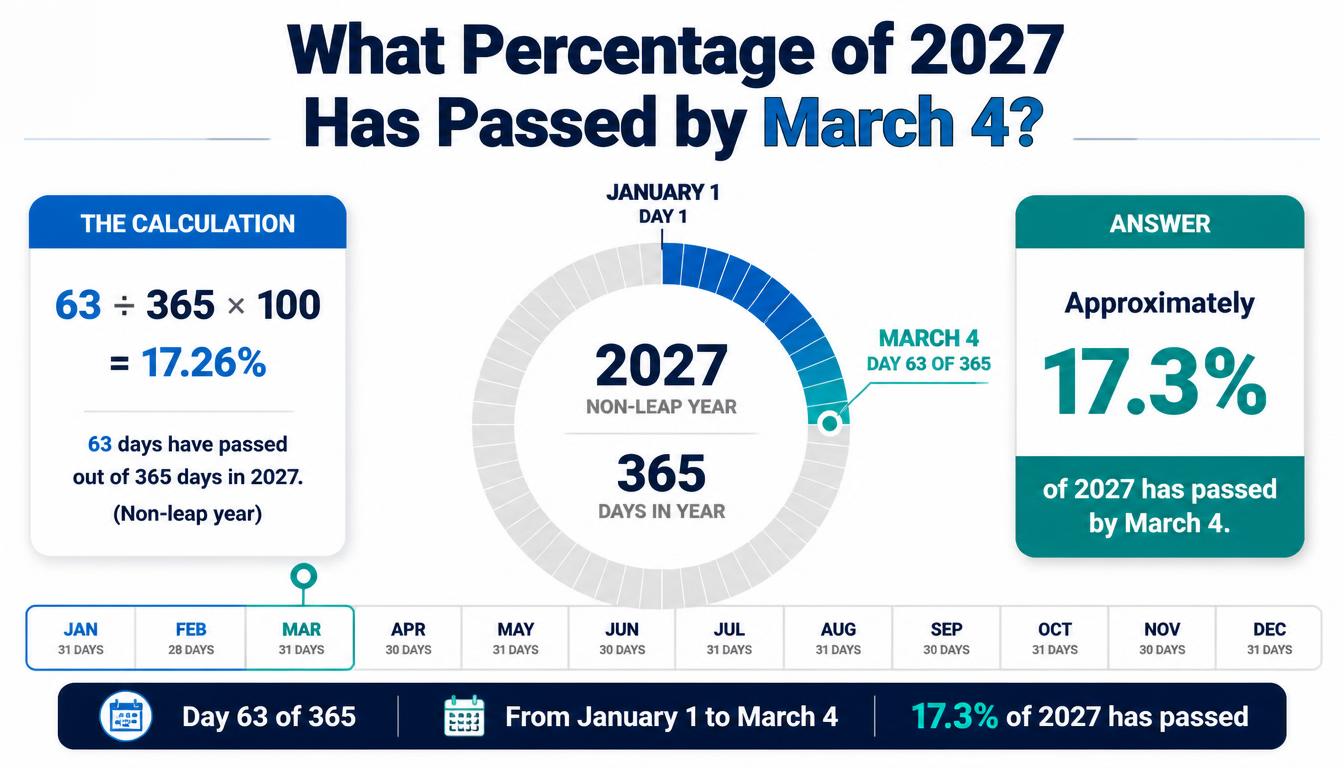
By March 4, 2027, approximately 17.26% of the year has elapsed, using the day-of-year calculation of 63 divided by 365.
The calculation is:
\[ \frac{63}{365}\times100 \approx 17.26\% \]
This percentage uses an inclusive day-of-year convention: March 4 is counted as day 63. If you instead measure only the fully completed days before March 4 begins, the result is slightly different.
This distinction matters because year-progress calculations can use different conventions. A website might measure the percentage of the year completed at the start of a date, at the end of a date, or at the current time.
For practical planning, the exact percentage is less important than the larger idea: March 4 comes relatively early in the year. You still have more than four-fifths of 2027 ahead of you when that date arrives.
How Many Months Is 20 Weeks?
Twenty weeks is approximately four and a half to five months, depending on how you compare weeks with calendar months.
There is no exact fixed conversion between weeks and months because months have different lengths. February can have 28 or 29 days, while months such as January and March have 31 days.
Twenty weeks contains 140 days. Dividing that by the average length of a Gregorian calendar month gives approximately 4.6 months.
This estimate is useful when you want a quick sense of the time period, but it should not replace an exact date calculation.
If you are arranging an appointment or setting a deadline, 20 weeks is the more precise description of the period, while March 4, 2027, is the specific calendar result for this example.
Practical Uses for a 20-Week Date Calculation
A future date can be more than a number on a screen. It can be the point around which you build a plan, measure progress, or prepare for something important.
Personal Goals and Habits
Suppose you want to learn a language, develop a creative skill, or finish a personal project. Twenty weeks gives you time to divide a large goal into smaller, manageable steps.
You could set weekly targets and review your progress every month. The final date becomes a checkpoint rather than a source of pressure.
Education and School Projects
Students may use a 20-week period to plan revision, organize research, or prepare for a major assignment. By identifying the final date first, it becomes easier to decide when each stage should be completed.
A calendar with smaller milestones can be more useful than one large deadline sitting in the distance.
Work and Project Management
Teams often need to plan projects that stretch across several months. Calculating the end date helps people schedule meetings, estimate workloads, and communicate deadlines clearly.
When working with colleagues in different regions, confirm the relevant calendar and any local holidays before finalizing the schedule.
Family Events and Travel
A future date can also help with planning family visits, celebrations, and trips. You may need time to coordinate schedules, make arrangements, or confirm availability.
Writing the date down early gives everyone a shared reference point. It also makes it easier to work backwards and identify what needs to happen first.
General Life Planning
Sometimes, there is no major event at all. You may simply want to know where a particular day falls on the calendar. That’s a perfectly good reason to use a weeks from today calculator.
A date doesn’t need to be attached to a huge goal to be useful. Even a small reminder can help bring a little order to a busy week.
Calculate Other Dates From Today
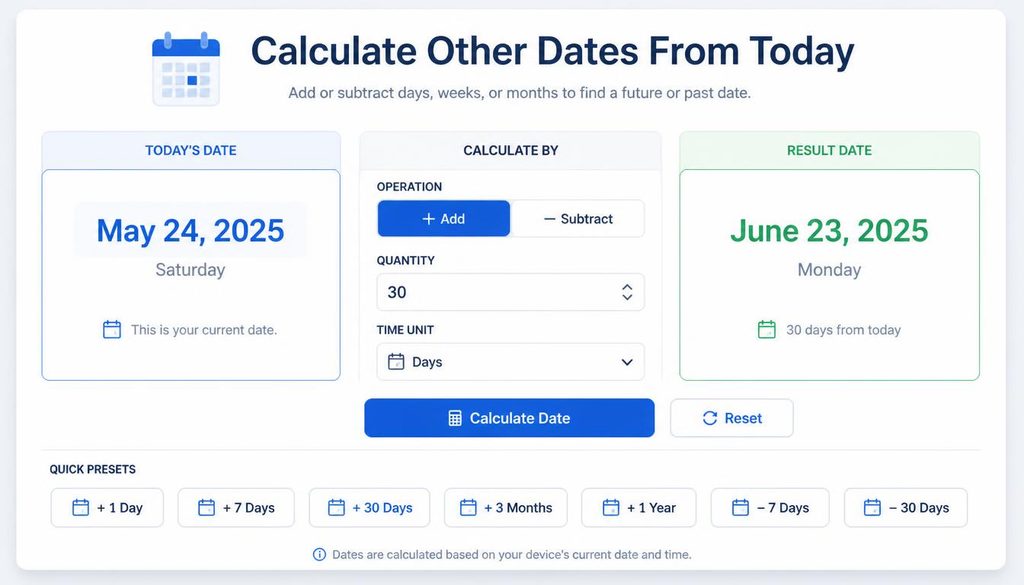
The same method used for 20 Weeks From Today can be applied to other periods. You simply multiply the number of weeks by seven and add the resulting days to your starting date.
For example, you can explore:
- 3 weeks from today for a short-term deadline.
- 4 weeks from today for a monthly progress check.
- 8 weeks from today for a medium-term project milestone.
- 12 weeks from today for a quarterly planning period.
- 16 weeks from today for a longer study or work schedule.
- 19 weeks from today to compare a date just before the 20-week mark.
- 21 weeks from today to see the date one week after your target.
These related calculations are useful when you’re comparing deadlines or creating a sequence of milestones. If you need a date in the past instead, a calculator can also help you determine what date it was a certain number of weeks ago.
Remember that the starting date matters. A calculation made today may produce a different result from the same calculation performed next week. For that reason, always enter the correct date instead of relying on an old result.
Tips for Getting Accurate Results From a Future Date Calculator
Even simple calculations can go wrong when the input is incorrect. A few quick checks can make your result more dependable.
- Confirm the starting date. Make sure the calculator is using the date you intended.
- Choose weeks rather than days when appropriate. If your target is 20 complete weeks, enter 20 weeks or 140 days.
- Check the calendar year. Adding weeks may move you into the following year.
- Verify the weekday. When adding a whole number of weeks, the weekday should remain the same.
- Understand the counting method. Adding 140 days normally means moving forward 140 days, not counting the starting date as day one.
- Check time zones for timed events. A date-only result may not be enough if the event begins at a particular hour in another location.
- Recalculate when plans change. If your starting date changes, the result will change too.
These steps are especially useful when a date affects travel, school, work, or an important appointment. It’s better to take a moment to verify the result than to discover later that you counted from the wrong starting point.
Frequently Asked Questions
20 weeks from today
20 weeks from October 15, 2026, is March 4, 2027, which falls on a Thursday.
what is 20 weeks from today
The date 20 weeks from today is March 4, 2027, after adding 140 days to October 15, 2026.
when is 20 weeks from now
20 weeks from now will be Thursday, March 4, 2027.
what day is 20 weeks from now
20 weeks from now will be a Thursday, specifically March 4, 2027.
what day was it 20 weeks ago
20 weeks ago from October 15, 2026, was Thursday, May 28, 2026.
Read This Blog:https://elvaronixy.com/date-calculator-12-weeks-from-today/
Conclusion
Finding 20 Weeks From Today is a simple calculation, but knowing the result can make future planning much easier. Starting from October 15, 2026, the date falls on Thursday, March 4, 2027, exactly 140 days later.
Along with the date itself, you now know that March 4 is the 63rd day of the year, falls in ISO week 9, and leaves 302 days remaining in 2027 after that date.
These details can be useful when you’re planning deadlines, organizing a project, or simply trying to understand where a particular day fits into the calendar.
The easiest approach is to start with a reliable date, calculate the number of days, and verify the result on a calendar or with a date calculation tool. Once the date is clear, you can focus on what you want to accomplish before it arrives.
And here’s a little reminder: a date on the calendar is not just a number waiting in the future. It is an opportunity to prepare, make progress, and give your plans a proper place in time.
If you’ve been using a particular method to calculate future dates, or you have another date you’d like to check, share your experience or question in the comments. Sometimes the simplest calendar questions lead to the most useful planning tips.