
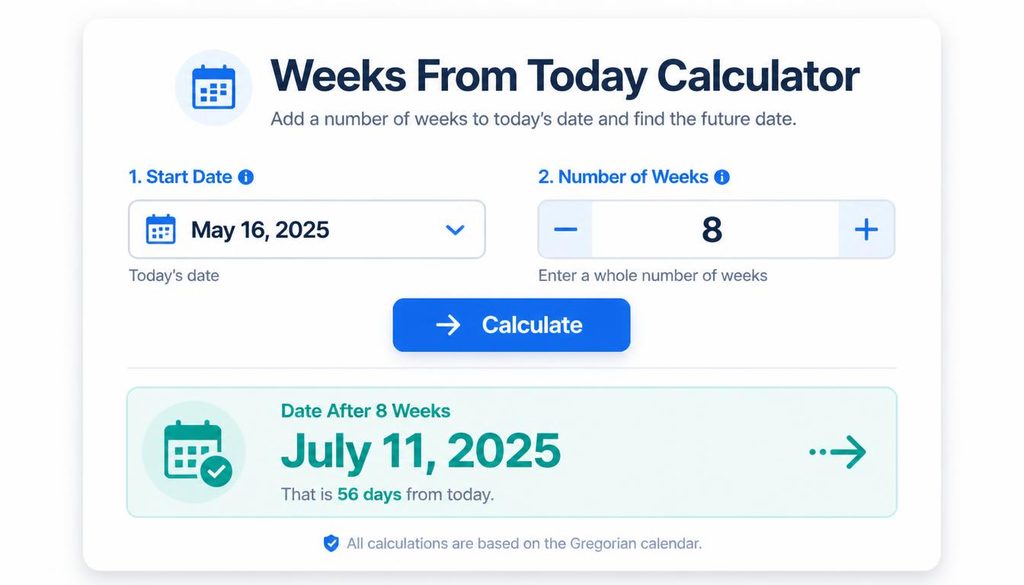
Have you ever looked at a calendar and wondered what the date would be three weeks from now, or perhaps twelve weeks into the future?
It sounds like a tiny question, something you could answer in a few seconds, but when work deadlines, appointments, holidays, school schedules, and personal plans begin to pile up, finding the right date suddenly becomes more important than expected.
A Weeks From Today Calculator makes this little task wonderfully simple. Instead of counting each day on a calendar and accidentally skipping a week, you can calculate a future date by entering the number of weeks you want to move ahead.
The result gives you the calendar date, and often the exact day of the week too.
Think about planning a family gathering, preparing for an examination, organizing a small business project, or waiting for a special occasion. Knowing the date several weeks ahead helps you breathe a little easier.
There is something reassuring about seeing a plan written down instead of keeping it floating around in your head.
This guide explains how a week-from-today calculator works, how to calculate future dates manually, and how to use date calculations for everyday planning. You’ll also learn about common mistakes, calendar differences, and simple ways to make your schedule more reliable.
| Weeks | Days | Calculation |
|---|---|---|
| 1 week | 7 days | Today + 7 days |
| 2 weeks | 14 days | Today + 14 days |
| 3 weeks | 21 days | Today + 21 days |
| 4 weeks | 28 days | Today + 28 days |
| 6 weeks | 42 days | Today + 42 days |
| 8 weeks | 56 days | Today + 56 days |
| 10 weeks | 70 days | Today + 70 days |
| 12 weeks | 84 days | Today + 84 days |
What Is a Weeks From Today Calculator?
A Weeks From Today Calculator is an online tool that determines a future calendar date by adding a chosen number of weeks to today’s date. You enter an interval, such as 2, 5, 10, or 20 weeks, and the calculator identifies the date that falls at the end of that period.
One week contains seven days. Therefore, adding one week moves a date forward by seven calendar days, while adding four weeks moves it forward by 28 days.
For example, suppose today is Saturday, October 10, 2026. If you add one week, the result is Saturday, October 17, 2026. Add four weeks, and you arrive at Saturday, November 7, 2026.
The day of the week remains the same when you add a whole number of weeks. That makes the calculation easier than working with months, whose lengths vary.
A Week-from-today calculator is useful for people who need quick answers without opening a paper calendar or manually counting every date. Depending on the tool, you may also be able to enter a starting date other than today.
How to Use a Weeks From Today Calculator Online
Using a free calculator is generally straightforward. Most tools are designed to provide a result without requiring an account, complicated settings, or technical knowledge.
Here is the usual process:
- Open a Weeks from today calculator online.
- Enter the number of weeks you want to add.
- Confirm that the starting date is today, unless you want to calculate from another date.
- Select the calculate button if the tool requires it.
- Read the resulting future date and the corresponding day of the week.
- Record the answer in your calendar, planner, or scheduling application.
For example, if you want to know the date six weeks from now, enter 6. The calculator adds 42 days to the starting date and displays the answer.
Some tools also work as a Date calculator, allowing you to add days, weeks, or months. Others offer a Future date calculator that can calculate dates from any selected starting point.
The most useful calculator is the one that clearly displays the starting date, the selected interval, and the final result. This helps you verify the calculation instead of simply trusting a number on the screen.
Weeks From Today Calculator: Example Date Chart
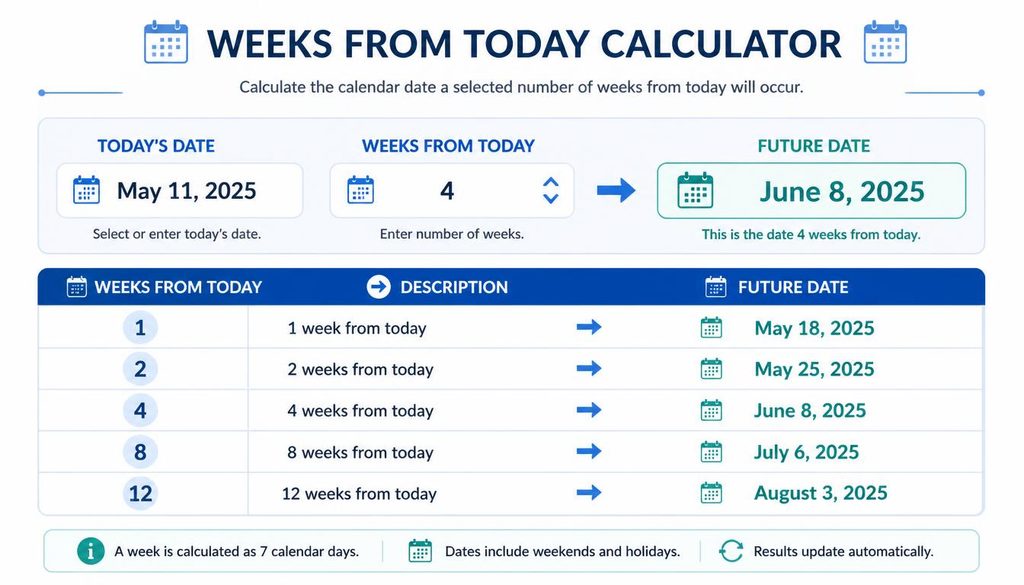
A date chart gives you a quick overview of common weekly intervals. The following examples use Saturday, October 10, 2026, as the starting date.
| Weeks from today | Days added | Future date |
|---|---|---|
| 1 week | 7 days | Saturday, October 17, 2026 |
| 2 weeks | 14 days | Saturday, October 24, 2026 |
| 3 weeks | 21 days | Saturday, October 31, 2026 |
| 4 weeks | 28 days | Saturday, November 7, 2026 |
| 5 weeks | 35 days | Saturday, November 14, 2026 |
| 6 weeks | 42 days | Saturday, November 21, 2026 |
| 8 weeks | 56 days | Saturday, December 5, 2026 |
| 10 weeks | 70 days | Saturday, December 19, 2026 |
| 12 weeks | 84 days | Saturday, January 2, 2027 |
| 16 weeks | 112 days | Saturday, January 30, 2027 |
| 20 weeks | 140 days | Saturday, February 27, 2027 |
| 26 weeks | 182 days | Saturday, April 10, 2027 |
| 52 weeks | 364 days | Saturday, October 9, 2027 |
Notice that 52 weeks do not always bring you to the same calendar date one year later. A normal year contains 365 days, and a leap year contains 366 days. Because 52 weeks contain only 364 days, the dates can differ.
This is an important detail when planning annual appointments, yearly events, or deadlines that must fall on a specific calendar date.
How to Calculate Weeks From Today Manually
You don’t always need an online tool. If the interval is simple, you can calculate weeks from today with basic arithmetic.
The process involves converting weeks into days and then moving forward on a calendar.
Step One: Identify Today’s Date
Start with the correct current date. If your phone and computer use different time zones, make sure you use the date relevant to your location.
For this example, we’ll use October 10, 2026.
Step Two: Convert Weeks Into Days
Multiply the number of weeks by seven.
For example:
- 2 weeks equal 14 days.
- 5 weeks equal 35 days.
- 8 weeks equal 56 days.
- 12 weeks equal 84 days.
This conversion gives you the number of calendar days to add.
Step Three: Move Forward on the Calendar
Suppose you need to find the date five weeks from October 10, 2026. Five weeks equal 35 days. Adding 35 days gives November 14, 2026.
The answer is Saturday, November 14, 2026.
Step Four: Verify the Exact Day
Check the final date using a calendar or Day and date finder. This is especially useful when the result will appear on an invitation, business notice, travel itinerary, or official schedule.
Manual calculations work well, but a calculator becomes more convenient when the interval is long or when you need to calculate several dates in one sitting.
Why Weeks Are Easier to Calculate Than Months
People sometimes treat four weeks as the same thing as one month. In casual conversation, this is understandable, but the two measurements aren’t exactly equal.
Four weeks contain 28 days. Calendar months contain 28, 29, 30, or 31 days.
Consider these examples:
- Adding four weeks means adding 28 days.
- Adding one calendar month means moving to the corresponding date in the following month, subject to the calendar tool’s end-of-month rules.
- Adding 12 weeks means adding 84 days.
- Adding three calendar months can produce a different result from adding 12 weeks.
Imagine your rent payment is due on October 31. Moving one calendar month forward may take you to November 30, depending on the applicable billing rules. Adding four weeks instead takes you to November 28.
That small difference can matter more than expected.
For a fixed number of weeks, use a weekly date calculator. For monthly anniversaries, recurring billing dates, or events tied to a particular day of the month, use a calendar-month calculation instead.
Practical Uses of a Weeks From Today Calculator
Date calculations aren’t just for people who enjoy organizing calendars. They are useful in everyday situations where knowing the timing makes a real difference.
Deadline Planning
Students, freelancers, employees, and business owners often receive deadlines several weeks in advance. A deadline date calculator helps determine the final date so work can be divided into smaller tasks.
Suppose a project is due eight weeks from today. You can identify the deadline, create weekly milestones, and decide when to finish research, complete a draft, review the work, and submit the final version.
The trick is not simply knowing the deadline. It is giving yourself enough time to reach it without turning the last two days into a frantic race.
Event Planning
Weddings, family gatherings, birthdays, community meetings, and religious celebrations often require weeks of preparation.
A Weeks From Today Calculator helps you establish important milestones, such as booking a venue, sending invitations, confirming guests, ordering supplies, and arranging transportation.
For instance, if an event is planned ten weeks ahead, you can work backward from the date to create a practical checklist.
Not every task needs to happen immediately. Some decisions are better made early, while others can wait until closer to the event.
School and Examination Schedules
Students can use date calculations to determine how many weeks remain before an examination, assignment deadline, or admission test.
If an examination is eight weeks away, a student could allocate the first five weeks to learning the material, the next two weeks to revision, and the final week to practice questions and rest.
Of course, the ideal study plan depends on the subject and the student’s current preparation. Still, having an exact date provides a useful starting point.
Travel and Holiday Preparation
Travel planning often involves passport checks, accommodation bookings, ticket reservations, packing, and coordinating with family members.
An online week calculator can help you establish when to complete each task. If a trip is scheduled twelve weeks from today, you have a clear timeframe for arranging the major details.
Remember that the calculation itself does not account for visa processing times, public holidays, or changing travel requirements. Those details should be checked separately.
Personal Goals and Habits
People frequently begin a new exercise routine, reading challenge, savings plan, or learning project with enthusiasm. After a few weeks, everyday responsibilities may get in the way.
A future date gives the goal a visible endpoint.
For example, you might set an eight-week target for reading a book series, practising a language, or building a consistent walking habit. You can review your progress every week instead of waiting until the final day to discover what happened.
Weeks From Today Calculator for Business and Work Schedules
Business planning becomes easier when important dates are calculated consistently. Even a small shop, design studio, workshop, or independent service provider may need to coordinate orders, customer appointments, deliveries, and staff schedules.
A Date calculator for planning helps turn vague instructions into specific calendar dates.
Suppose a customer approves a design and requests delivery in three weeks. Recording the exact delivery date makes the commitment easier to track. You can also set an internal review date several days earlier, leaving room for revisions.
Similarly, a supplier might promise to deliver materials in six weeks. Adding that interval to the order date provides an expected arrival date, although it should not be treated as a guarantee of delivery.
For ongoing work, use schedule planning to organize recurring tasks and event planning to coordinate one-time activities. A Selected interval should always be recorded clearly, particularly when different people are working from the same schedule.
A simple spreadsheet can include the task, starting date, number of weeks, calculated deadline, responsible person, and completion status. This small habit prevents many avoidable misunderstandings.
Understanding Date Calculation and Calendar Accuracy
A good Date calculation should be precise about what is being added and which date serves as the starting point.
Most week-based calculations follow a simple rule: each week equals seven calendar days. However, several details can influence how you interpret the result.
Calendar Days Versus Working Days
Calendar weeks include Saturdays and Sundays. If you add two weeks to a date, you add 14 calendar days, not 10 working days.
Working-day calculations are different because they may exclude weekends and public holidays. A business deadline described as ten working days away should not automatically be calculated as two calendar weeks.
Always check the wording of an agreement or deadline before deciding which calculation to use.
Time Zones and Midnight
If you calculate a date near midnight, the local date may differ from the date displayed by a server or an online tool operating in another time zone.
For ordinary date planning, this is rarely a problem when the tool uses your local date. For international meetings, flights, and online events, it is worth confirming the time zone as well as the date.
Leap Years
Leap years add an extra day to February. This matters when calculating long periods that cross February or when comparing a date several months ahead with the same date in a later year.
Adding a fixed number of weeks remains straightforward because each week still contains seven days. The leap day is simply part of the calendar days crossed along the way.
Daylight Saving Time
Some countries move their clocks forward or backward during the year. This can affect calculations involving exact times and elapsed hours, even though the calendar-date result for a whole number of weeks is usually clear.
If an appointment must occur at a specific local time, verify both the date and the time zone.
Choosing the Right Free Online Calculator

Not every date tool offers the same features. Before relying on a free online calculator, consider what you actually need.
A basic tool may be sufficient if you only want to add a few weeks to today’s date. A more advanced Future date calculator can be useful if you need to start from a custom date, compare different intervals, or calculate a deadline months ahead.
Look for these features:
- Clear display of the starting date.
- An easy way to enter the number of weeks.
- The final calendar date and day of the week.
- Support for dates other than today.
- A simple interface that works on mobile devices.
- Clear explanations of whether the tool uses calendar days or working days.
Privacy is another sensible consideration. A basic date calculation generally does not require personal information. If a tool asks you to provide unnecessary details just to calculate a future date, consider using another option.
The best tool isn’t necessarily the one with the most buttons. It is the one that gives you the right answer in a way you can understand and verify.
Common Mistakes When Calculating Future Dates
Date calculations seem simple until one small assumption changes the answer. These are some common mistakes worth avoiding.
Confusing weeks with months: Four weeks equal 28 days, not a complete calendar month in every case.
Counting today as the first day: When you add one week to October 10, you arrive at October 17. You don’t count October 10 as an additional day after the starting date.
Ignoring weekends: Adding weeks counts all seven days of each week, including weekends.
Using the wrong starting date: A calculator may use today’s date, while you may actually need to calculate from the date an order was placed or a document was signed.
Forgetting the year: A result in January may belong to the next calendar year. Always record the year when the interval crosses December.
Assuming a deadline is automatically extended: If a calculated due date falls on a weekend or public holiday, the applicable contract, institution, or authority may have specific rules. Do not assume the deadline moves without checking.
A reliable date interval calculator makes the arithmetic easier, but you still need to interpret the result correctly.
How to Calculate Dates for Different Starting Points
A useful calculator should ideally allow you to add weeks to any date, not only today.
Suppose a course begins on November 2, 2026, and you want to know when a six-week course ends. Enter November 2 as the starting date and add six weeks, or 42 days.
The result is December 14, 2026.
This approach is helpful for contracts, training programmes, product launches, and project schedules that begin on a specific date.
You can also use the reverse approach when you already know the target date. If an event is scheduled for December 14, 2026, you can calculate backward to find the date six weeks earlier.
That backward calculation is particularly useful when working out when invitations should be sent, when preparations should begin, or when a project must start to meet its deadline.
The important point is to use the correct starting date rather than automatically assuming the interval begins today.
Tips for Making Future Date Planning More Effective
Knowing the exact date is a good beginning, but a little organization makes that information much more valuable.
First, write the final date in your calendar immediately. A result that stays on a calculator screen is easy to forget.
Second, add reminders before the deadline. If a project is due in six weeks, you might schedule a progress review after two weeks and another after four weeks.
Third, leave room for unexpected delays. Materials may arrive late, appointments may change, and other responsibilities may take longer than planned. A reasonable buffer can make your schedule more realistic.
Fourth, share important dates with the people involved. A family event, team project, or customer order becomes easier to coordinate when everyone works from the same date.
Finally, review your calendar regularly. A Weeks From Today Calculator can identify the future date, but it cannot decide which tasks deserve attention first. That part still depends on your priorities.
Frequently Asked Questions
What Is a Weeks From Today Calculator?
A Weeks From Today Calculator helps you find the exact future date by adding a specific number of weeks to today’s date.
How Do I Calculate Weeks From Today?
Multiply the number of weeks by 7 to get the total days, then add those days to today’s date.
What Date Will It Be 4 Weeks From Today?
Four weeks from today is 28 days from the current date. Use the calculator to find the exact date.
Can I Calculate Multiple Weeks From Today?
Yes, you can calculate dates several weeks ahead, such as 6, 10, 12, or 20 weeks from today.
Is a Week Always 7 Days?
Yes, a standard calendar week contains 7 days, so you can calculate future dates by multiplying weeks by 7.
Read This Blog:https://elvaronixy.com/tools-days-30/
Conclusion: Make Every Week Count
A Weeks From Today Calculator is a small tool with a surprisingly wide range of uses.
It can help you identify the date of an upcoming examination, prepare for a family celebration, schedule a customer delivery, organize a business project, or simply answer a question that has been sitting in your mind.
The process is simple: choose the starting date, select the number of weeks, and calculate the result. Because every week contains seven days, the arithmetic is consistent, even when the calculation crosses a month or a year.
Still, the real benefit is not just finding a date. It is being able to plan with more confidence. When you know how much time remains, you can divide a big responsibility into manageable steps and avoid leaving everything until the last minute.
Use a free calculator for quick answers, confirm important dates with a calendar, and remember to check any special rules that apply to official deadlines or working days.
Whether you’re planning something exciting, preparing for a busy period, or simply curious about the future, a little date planning can make the weeks ahead feel much more organized.
What is the next date you’re trying to calculate? Share your favourite date-planning tip or tell us how you use a week calculator in your everyday life. Your approach might help someone else organize their plans a little better, too.