

Have you ever looked at a calendar and wondered what date would appear after several months of waiting?
Perhaps you’re planning a personal goal, preparing for an important event, organizing a work project, or simply curious about a date far enough into the future that counting the weeks on your fingers becomes a little confusing. W
hatever brought you here, finding the right date doesn’t have to feel like solving a puzzle with missing pieces.
When we talk about 16 Weeks From Today, we’re looking at a period that stretches across 112 days. That’s enough time for plans to grow, routines to change, and new opportunities to take shape.
A date that seems far away today can arrive surprisingly quickly, especially when ordinary life keeps moving at its familiar pace.
Using the current date of October 16, 2026, the date sixteen weeks into the future is Friday, February 5, 2027. This guide explains the calculation, the weekday, important calendar details, and practical ways to calculate other future dates without getting lost among the numbers.
| Calculation | Result |
|---|---|
| Today’s Date | October 16, 2026 |
| Weeks to Add | 16 Weeks |
| Total Days | 112 Days |
| Date After 16 Weeks | February 5, 2027 |
| Day of the Week | Friday |
| Weeks in Days | 16 × 7 = 112 Days |
What Is 16 Weeks From Today?
Sixteen weeks is a straightforward period of time, even if finding the exact date requires a little calendar arithmetic. Every week contains seven days, so multiplying sixteen by seven gives us the total number of days to add to today’s date.
Here’s the basic calculation:
- Starting date: October 16, 2026
- Number of weeks: 16
- Days in each week: 7
- Total duration: 16 × 7 = 112 days
- Future date: February 5, 2027
- Day of the week: Friday
Therefore, the answer to What date is 16 weeks from today is Friday, February 5, 2027.
This calculation follows the Gregorian calendar, the calendar system used in most countries for everyday dates. Because sixteen weeks represents an exact number of seven-day periods, the weekday remains the same.
October 16, 2026, is a Friday, and February 5, 2027, is also a Friday. It’s a neat little detail that makes checking the answer easier.
16 Weeks From Today Date at a Glance
Sometimes you don’t need a long explanation. You just want the answer, preferably before your coffee gets cold or your next appointment begins.
16 WEEKS FROM OCTOBER 16, 2026
Friday, February 5, 2027
Weeks ahead
16 weeks
Total days
112 days
Calendar year
2027
Weekday
Friday
The 16 weeks from today date is particularly useful when you’re scheduling a deadline, setting a reminder, planning a trip, or working toward a personal milestone.
Rather than estimating that something will happen in roughly four months, you can mark the exact date on your calendar and plan around it.
How to Calculate 16 Weeks From Today’s Date
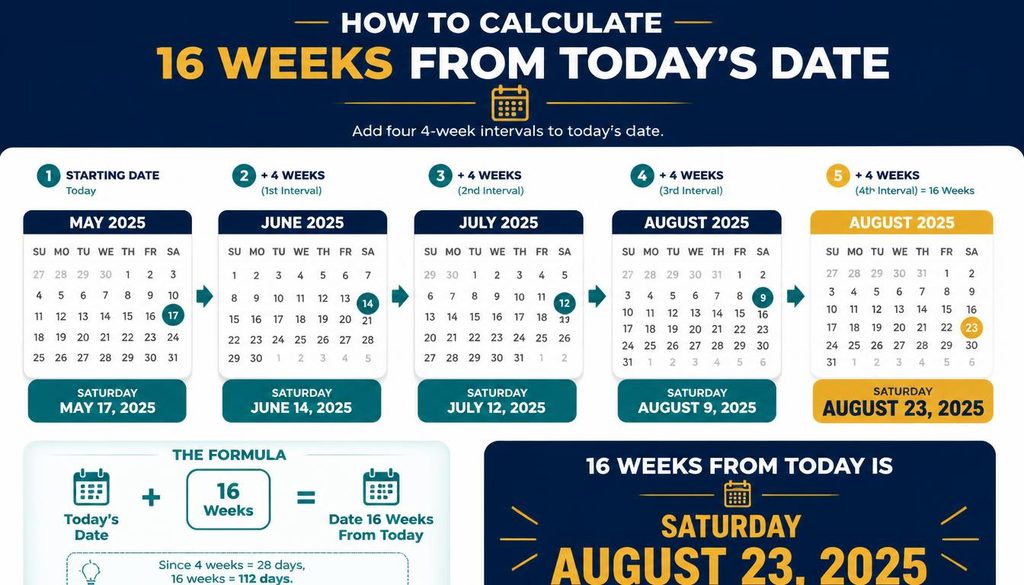
You don’t need advanced mathematics or a special app to determine a future date. The calculation involves simple multiplication followed by counting forward on a calendar. Once you understand the method, you can use it for almost any number of weeks.
Step 1: Convert Weeks Into Days
Start by multiplying the number of weeks by seven.
For sixteen weeks:
16 × 7 = 112 days.
This gives you the duration required for your calendar date calculation. It also answers the common question, “How many days are in 16 weeks?” The answer is exactly 112 days.
Step 2: Start With the Current Date
The starting point for this example is October 16, 2026. You can use the same approach with any other starting date, but be sure to enter the correct year as well as the month and day.
Step 3: Count Forward Through the Months
Instead of counting 112 individual squares on a calendar, move through the remaining days of October, then November, December, January, and finally February.
The calculation works like this:
- October 16 to November 16: 31 days.
- November 16 to December 16: 30 days.
- December 16 to January 16: 31 days.
- January 16 to February 5: 20 days.
Add those intervals together:
31 + 30 + 31 + 20 = 112 days.
The result is February 5, 2027. This method of adding 16 weeks to the current date is reliable because it accounts for the different lengths of calendar months.
Step 4: Confirm the Weekday
Finally, check the weekday using a printed calendar, a digital calendar, or a Future date calculator. The result is Friday.
If you calculate dates regularly, checking the weekday is a useful habit. It can help you avoid accidentally scheduling a meeting on a weekend or choosing a deadline that falls on a day your workplace is closed.
What Day Is 16 Weeks From Today?
The day sixteen weeks from October 16, 2026, is Friday, February 5, 2027.
There is a simple reason for this. Since every week contains seven days, adding a whole number of weeks preserves the weekday. Adding one week to a Friday gives you another Friday; adding sixteen weeks does the same.
This makes the calculation especially convenient when you’re planning recurring events, such as weekly meetings, classes, appointments, or family activities.
For example, if you have an event every Friday and want to schedule another one sixteen weeks later, you can use the date February 5, 2027, as your target. Just remember that public holidays, local business hours, and personal schedules may still affect whether that date is convenient.
Calendar Details for February 5, 2027
Knowing the date is helpful, but sometimes you need more information about where it falls within the calendar year. This can be useful for annual planning, project tracking, and understanding calendar week numbers.
| Calendar detail | Answer |
|---|---|
| Full date | Friday, February 5, 2027 |
| Month | February |
| Day of the month | 5 |
| Calendar year | 2027 |
| Day of the year | 36th day |
| ISO week number | Week 5 |
| Days elapsed before this date in 2027 | 35 |
| Days remaining after this date | 329 |
| Leap year | No |
February 5 is the 36th day of 2027 because January contributes 31 days, followed by five days in February. Adding them together gives 36.
One small but important detail concerns the Week of the year. Under the ISO week-numbering system, February 5, 2027, falls in Week 5, not Week 6. Some calendars use different week-numbering conventions, so the number displayed by a particular tool may vary depending on its settings.
Similarly, 329 days remain after February 5 when that date itself is excluded from the count. If you count February 5 as one of the remaining calendar dates, the total becomes 330 days.
How Many Months Is 16 Weeks?
Sixteen weeks is approximately four months, but the two measurements aren’t perfectly interchangeable.
A month doesn’t always contain four weeks. Depending on the month, it may have 28, 29, 30, or 31 days. Four calendar months can therefore be shorter or longer than 112 days.
From October 16, 2026, the date sixteen weeks later is February 5, 2027. Four calendar months after October 16 would be February 16, 2027, which is eleven days later.
This difference matters when you’re planning something that depends on an exact date. For example, a four-month subscription period might end on a different date from a sixteen-week program.
When accuracy matters, use weeks or days for the duration you were given rather than assuming every month equals four weeks.
Using a 16 Week Date Calculator
A 16 week date calculator can make future-date planning much easier. Instead of manually counting through several months, you enter a starting date, choose the number of weeks, and let the tool calculate the result.
A typical Date Calculator offers options for adding or subtracting days, weeks, or months. Some tools also display the weekday, the number of days between two dates, and other calendar information.
Here are a few situations where an online calculator can be useful:
- Project deadlines: Find the exact date sixteen weeks after a project begins.
- Study schedules: Set a target date for completing a course or revision plan.
- Travel planning: Calculate a future date for booking, preparation, or departure.
- Personal goals: Mark a milestone on the calendar so you can work toward it.
- Appointments: Calculate dates for follow-up visits or recurring activities.
- Event organization: Allow enough time to prepare invitations, supplies, and arrangements.
For a quick calculation, you can use the following interactive date calculator.
Weeks From Today Calculator
Choose a starting date and calculate a date before or after it.Starting date
10/16/26Number of weeks
1
16
32
52
16
Calculate dateWeeks after the starting dateWeeks before the starting date
Calculated future or past date
Friday, February 5, 2027
16 weeks = 112 days Copy calculated date
A weeks from now calculator is particularly helpful if you need to repeat the calculation for several different time periods. You can adjust the starting date and number of weeks without starting the process from scratch.
Understanding the Day of the Year
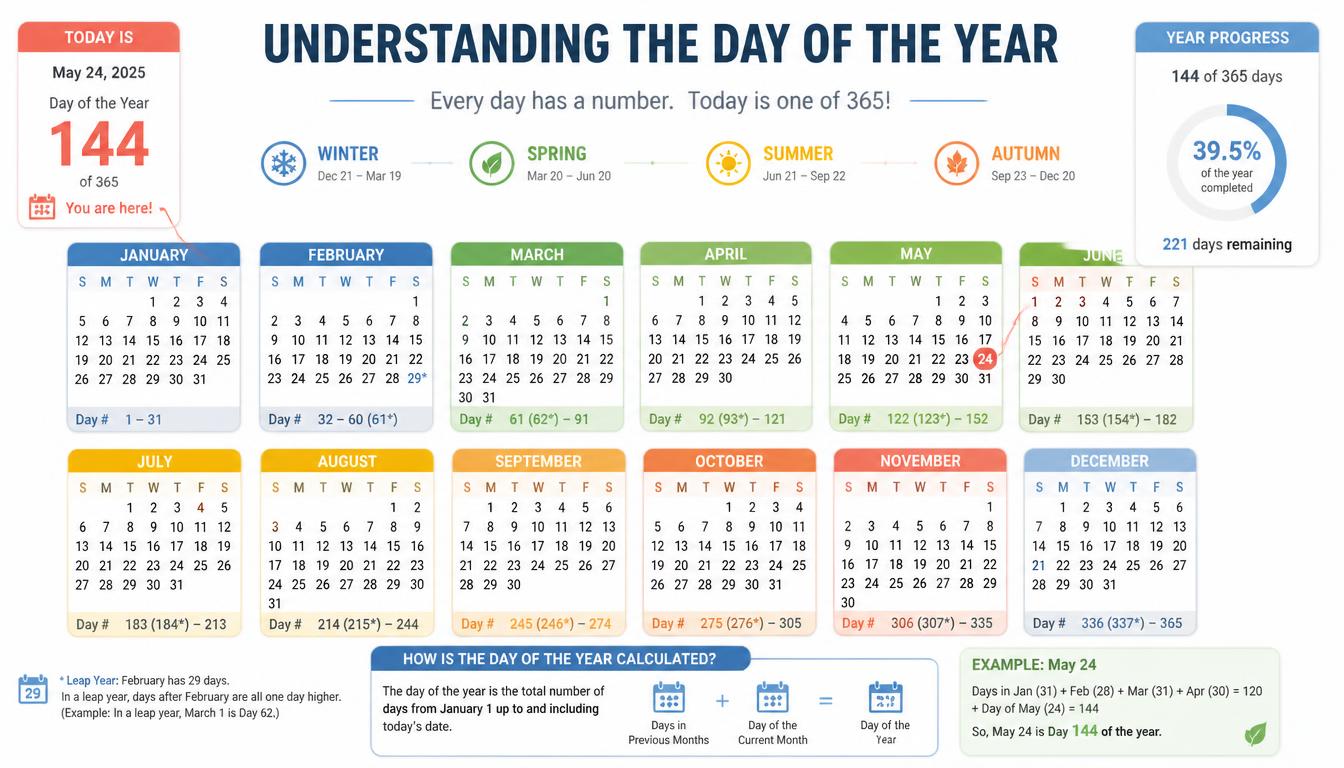
The Day of the year is a number that identifies the position of a date within a calendar year. January 1 is day 1, January 2 is day 2, and the count continues until December 31.
February 5, 2027, is day 36 of the year.
Here’s the calculation:
- January contains 31 days.
- The first five days of February add another five days.
- Total: 31 + 5 = 36.
This information can be useful in data analysis, annual reporting, agricultural planning, and other situations where a date needs to be expressed as a number within the year.
For example, if a project tracker records progress by day of the year, February 5 can be entered as day 36. The method is straightforward, though leap years require an extra day to be included after February.
How Much of 2027 Has Passed by February 5?
The year 2027 contains 365 days because it is not a leap year. By February 5, 36 calendar days have been reached if the date itself is included in the count.
Using that inclusive count, the percentage of the year represented is approximately:
\[ \frac{36}{365}\times100 \approx 9.86\% \]
There is another way to measure elapsed time: count only the full days before February 5. In that case, 35 days have elapsed, which is approximately 9.59% of the year.
These two calculations answer slightly different questions. One measures the position of the date within the year, while the other measures the amount of time completed before that date begins.
This distinction is useful when comparing the percentage of the year completed across calendars, progress reports, and online tools. Always check whether the calculation includes the current date.
Related Date Calculations You May Find Useful
Once you’ve learned how to calculate sixteen weeks into the future, other date questions become easier to answer. The same process works for shorter or longer intervals, whether you’re planning a few weeks ahead or looking several months into the future.
Here are some related calculations worth exploring:
- 15 weeks from today: One week earlier than the sixteen-week milestone.
- 17 weeks from today: One week later than the sixteen-week milestone.
- 20 weeks from today: A useful longer-term planning interval.
- 16 weeks ago from today: The equivalent calculation in the past.
- 112 days from today: The same duration expressed in days.
- 12 weeks from today: A shorter period for quarterly planning.
- 24 weeks from today: A period of approximately six months.
The results depend on the starting date, so always use the date relevant to your situation.
For example, if you want to calculate sixteen weeks before a deadline, subtract 112 days instead of adding them. This is the basic principle behind calculating weeks before a date and calculating weeks after a date.
16 Weeks From Today vs. 112 Days From Today
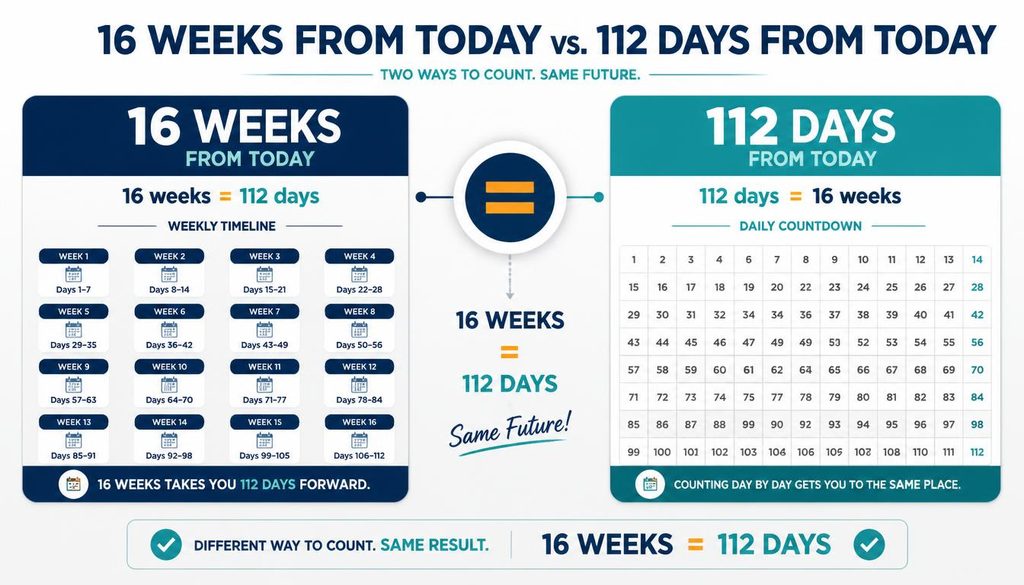
These two expressions describe exactly the same length of time. Sixteen weeks contain 112 days, so adding either duration to October 16, 2026, leads to February 5, 2027.
The difference is simply how the duration is expressed.
| Method | Calculation | Result |
|---|---|---|
| Weeks | 16 × 7 days | 112 days |
| Days | Add 112 calendar days | February 5, 2027 |
| Calendar result | Starting date plus duration | Friday, February 5, 2027 |
Weeks are often easier to use when planning routines, classes, and recurring meetings. Days can be more convenient for countdowns, project tracking, or precise intervals.
Both methods are valid, as long as you use the same starting date and count forward consistently.
Practical Tips for Planning Around a Future Date
Knowing the date is only the beginning. The real benefit comes from using it to organize your time and make your plans a little easier to manage.
Put the date on your calendar. Add February 5, 2027, to your digital or paper calendar if it marks an important deadline or event. A reminder can help prevent the date from sneaking up on you.
Work backward from the deadline. If you have a major task due in sixteen weeks, divide it into smaller weekly milestones. Instead of waiting until the final days, you can track your progress along the way.
Leave room for unexpected changes. Travel arrangements, work projects, and personal plans don’t always go exactly as expected. If the date matters, consider setting an earlier internal deadline.
Check the correct calendar year. A future date calculation can cross from one year into another, as this example does. Including the year helps avoid confusion when recording the result.
Use a calculator for repeated calculations. A reliable online date calculator can save time when you’re comparing several possible deadlines or planning events across different months.
A little preparation can make a distant date feel much more manageable. You don’t have to plan every minute between now and February; simply knowing your target date gives you a useful starting point.
Common Mistakes When Calculating Weeks Into the Future
Even a simple calculation can become confusing if the starting point or counting method is unclear. Fortunately, the most common mistakes are easy to avoid.
One mistake is treating every month as if it contains exactly four weeks. Since calendar months have different lengths, sixteen weeks doesn’t always equal four calendar months.
Another is counting the starting date as the first day of the new period. In ordinary date arithmetic, adding 112 days means moving forward by 112 days from the starting date, rather than counting the starting date as day one.
It’s also worth checking the weekday and year. When a calculation crosses December into January, it’s easy to write the correct month and day but accidentally use the wrong year.
Finally, don’t confuse the ISO week number with the day number of the year. February 5, 2027, is in ISO Week 5 and is the 36th day of the year. These numbers describe two different calendar measurements.
By checking the starting date, duration, and final result, you can avoid most calculation errors without making the process complicated.
Frequently Asked Questions
what is 16 weeks from today
16 weeks from today is February 5, 2027, which falls on a Friday.
16 weeks ago from today
16 weeks ago from October 16, 2026, was June 26, 2026, a Friday.
16 weeks ago
16 weeks ago was June 26, 2026. This date is exactly 112 days before October 16, 2026.
16 weeks from now
16 weeks from now is February 5, 2027. It is exactly 112 days from October 16, 2026.
what date is 16 weeks from today
The date 16 weeks from today is February 5, 2027. This calculation adds 112 days to the current date.
Read This Blog:https://elvaronixy.com/date-calculator-20-weeks-from-today/
Conclusion
Finding 16 Weeks From Today is easier than it might first appear. Starting from October 16, 2026, the exact date is Friday, February 5, 2027.
Sixteen weeks equal 112 days, and understanding that simple relationship makes it easier to calculate future dates, check weekdays, and organize important milestones.
Whether you’re managing a project, preparing for an event, setting a personal goal, or simply satisfying your curiosity, a clear date gives you something concrete to work toward.
Use a calendar or date calculator when you need extra confirmation, and remember to check the year and weekday before finalizing an important plan.
Time moves forward one day at a time, but a little planning can help you make those days count. If you have a favorite method for calculating future dates or another date-related question, share it in the comments. Your approach might help someone else plan their next milestone with a little more confidence.