

Have you ever looked at a calendar and wondered how quickly the next few weeks will pass? Maybe you’re planning a family gathering, waiting for an important appointment, preparing for a special occasion, or simply curious about where you’ll be 5 Weeks From Today.
Sometimes, knowing a future date makes life feel a little more organized, even when the days ahead are full of surprises.
Imagine sitting down with a cup of tea, opening your calendar, and counting five weeks ahead. Suddenly, a vague plan becomes a real date you can circle, remember, and prepare for.
It’s a small thing, honestly, but knowing exactly when something will happen can make planning feel much easier.
If today is Friday, October 16, 2026, then five weeks from today will be Friday, November 20, 2026. That date is exactly 35 days into the future, giving you a useful point for scheduling events, tracking deadlines, or setting personal goals.
The calendar may look ordinary, but a date can be the beginning of something meaningful.
In this guide, we’ll explain the 5 weeks from today date, how to calculate it, which day of the week it falls on, and what it means for the remaining days of 2026.
You’ll also learn how a Date Calculator or Weeks From Today Calculator can help you find future dates without counting every single day on your fingers.
| Calculation | Date |
|---|---|
| Today | October 16, 2026 |
| 5 Weeks From Today | November 20, 2026 |
| Number of Weeks | 5 Weeks |
| Number of Days | 35 Days |
| Day of the Week | Friday |
| 5 Weeks Ago | September 11, 2026 |
What Date Is 5 Weeks From Today?
The answer depends on today’s date, so it’s always worth checking the calendar before making plans. Using Friday, October 16, 2026, as the starting date, five weeks later lands on Friday, November 20, 2026.
5 WEEKS FROM TODAY
Friday, November 20, 2026
35 days from today
Five complete weeks after October 16, 2026.
Friday
The future date falls on a weekday.
This is the Date 5 Weeks From Today when October 16, 2026, is your starting point. If you’re planning an event, arranging travel, or setting a reminder, you can use November 20 as your target date.
The useful part is that the weekday stays the same when you add a whole number of weeks. Five weeks contain five complete seven-day periods, so Friday remains Friday. No complicated calendar trick is needed, which makes this calculation surprisingly easy.
How Many Days Are in 5 Weeks?
Five weeks contain 35 days. This is because every standard calendar week has seven days, and multiplying five by seven gives you the total.
\[ 5 \times 7 = 35 \text{ days} \]
When someone asks for a date five weeks from now, they’re really asking you to move 35 days forward from the starting date. The calculation works whether you’re planning a meeting next month or setting a reminder for a personal milestone.
Here are a few equivalent ways to understand the duration:
| Time period | Equivalent duration |
|---|---|
| 5 weeks | 35 days |
| 5 weeks | 840 hours |
| 5 weeks | 50,400 minutes |
| 5 weeks | 3,024,000 seconds |
These conversions can be handy in different situations. For example, 35 days is useful for calendar planning, while 840 hours may be relevant when estimating a time period for a project or tracking a long-term schedule.
Remember that these are standard elapsed-time conversions. If you’re calculating a specific time across daylight-saving changes, the number of actual clock hours can differ in some locations. For an ordinary date-only calculation, however, five weeks simply means 35 calendar days.
How to Calculate 5 Weeks From Today
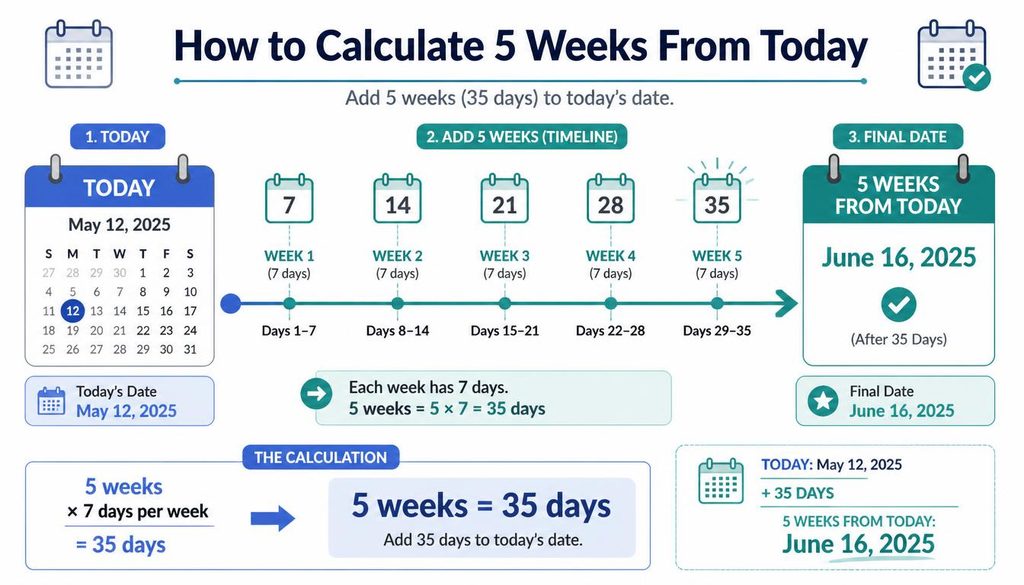
You don’t need to be a mathematics expert to Calculate Weeks From Today. A regular calendar is enough, and the process becomes even easier once you understand the basic rule.
Start with the current date, then move forward one week at a time. Each complete week advances the calendar by seven days.
For our example, the starting date is Friday, October 16, 2026.
| Step | Date |
|---|---|
| Starting date | Friday, October 16, 2026 |
| 1 week later | Friday, October 23, 2026 |
| 2 weeks later | Friday, October 30, 2026 |
| 3 weeks later | Friday, November 6, 2026 |
| 4 weeks later | Friday, November 13, 2026 |
| 5 weeks later | Friday, November 20, 2026 |
Notice how every date lands on a Friday. That’s because we’re moving forward by complete seven-day intervals instead of counting individual dates one by one.
There is also a quicker method. Take the starting date and add 35 calendar days. You can do this manually, use a calendar app, or enter the number of weeks into an online calculator.
Both methods produce the same result when you use the same starting date and calendar system.
Using a Weeks From Today Calculator
A Weeks From Today Calculator is helpful when you need to find a future date quickly. Instead of flipping through calendar pages or checking how many days each month contains, you can enter the number of weeks and let the tool handle the calculation.
This is especially useful when you’re dealing with dates several months away. Counting five weeks is fairly simple, but counting 17, 26, or 42 weeks can become a bit tedious.
A typical Online Date Calculator can help you:
- Calculate a date a specific number of weeks in the future.
- Find a date a certain number of days from now.
- Work backward to discover a date several weeks ago.
- Check the weekday associated with a future date.
- Calculate the number of weeks between two calendar dates.
- Plan deadlines, trips, appointments, and personal milestones.
For example, suppose you need to schedule a follow-up appointment five weeks after October 16. Enter the starting date, choose five weeks, and check the displayed result. You should see November 20, 2026.
Some tools also let you customize date calculation settings, choose a different starting date, or calculate dates using months and days instead of weeks. These features are useful when your schedule doesn’t fit into neat seven-day blocks.
A calculator can save time, but always make sure the starting date is correct. A perfectly calculated answer based on the wrong starting date will still lead to a scheduling mistake.
What Day Will It Be in 5 Weeks?
If today is Friday, October 16, 2026, then five weeks from today will also be Friday, November 20, 2026.
Why does the weekday stay the same? The answer is simple: seven days make one full week, and after seven days, the calendar returns to the same weekday. After 35 days, you’ve completed exactly five full weeks.
This makes the calculation especially convenient for recurring activities. If you normally attend a class every Friday, a meeting happens every Friday, or your family has a regular weekend tradition, adding five weeks keeps the weekday unchanged.
Of course, the calendar date changes. October 16 becomes November 20, but Friday remains Friday. It’s one of those small calendar details that can make planning easier than expected.
If you are scheduling an event, remember that the date and the time are separate things. A date calculator can tell you which day the event falls on, but you still need to confirm the event’s start time, location, and any time-zone differences.
Calendar Details for November 20, 2026
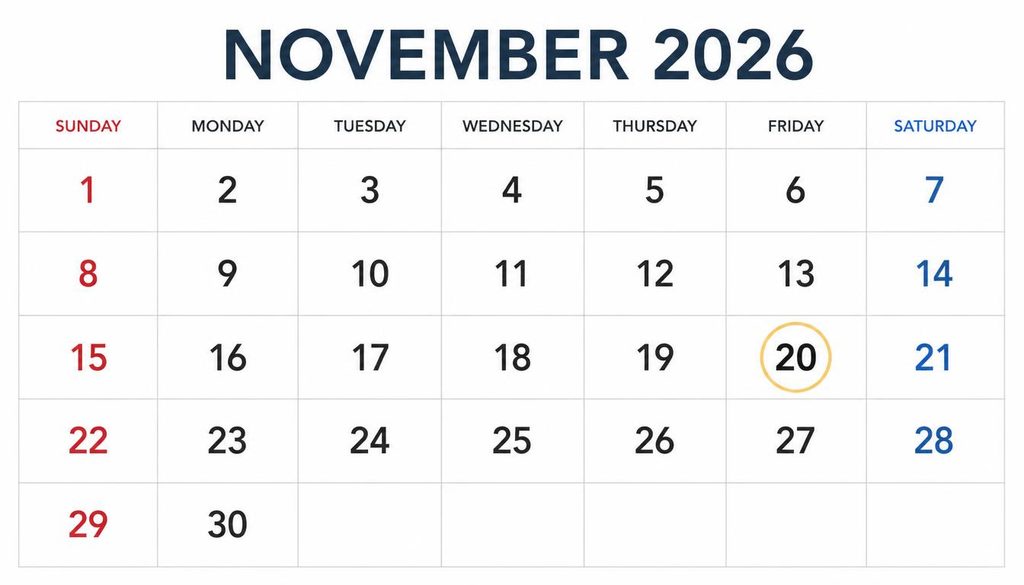
The date five weeks from October 16, 2026, has a few interesting calendar details. These facts can help you understand where the date sits within the year.
| Calendar detail | Answer |
|---|---|
| Future date | November 20, 2026 |
| Day of the week | Friday |
| Duration from October 16 | 5 weeks |
| Equivalent duration | 35 days |
| Week number | 47th week of 2026 |
| Day number of the year | 324th day |
| Days remaining after this date | 41 days |
| Percentage of the year completed | Approximately 88.77% |
November 20 is the 324th day of 2026. Because 2026 is not a leap year, it contains 365 days in total. Subtracting 324 from 365 leaves 41 days after November 20.
The year is also approaching its final stretch by this point. Many people begin preparing for winter holidays, reviewing their annual goals, and deciding which tasks need to be completed before December arrives.
One small but useful clarification: the percentage of the year completed depends on how it’s calculated. By November 20, 324 of the year’s 365 calendar days have elapsed when counting the current date as day 324.
That is approximately 88.77%. The percentage of full days elapsed before November 20 begins is slightly lower.
These distinctions matter when you need precise calendar information for reports, schedules, or date-based calculations.
What Week of the Year Is November 20, 2026?
November 20, 2026, falls in the 47th week of 2026 when using the ISO week-numbering system.
Week numbers are often used in business schedules, project planning, production calendars, and administrative reports. Instead of referring to a date alone, someone might say that a deadline falls in Week 47.
The ISO calendar starts each week on Monday. Its first week is the week containing the year’s first Thursday, which means the numbering system does not always line up with simply dividing the days of the year into blocks of seven.
For everyday planning, you don’t usually need to know the week number. However, it can be useful when coordinating schedules with colleagues or organizing a project that spans several months.
If your workplace or organization uses a different week-numbering convention, check its calendar settings before relying on the week number. Different systems can occasionally assign different week numbers to dates near the beginning or end of a year.
How Many Days Are Left in 2026 After November 20?
After November 20, 2026, there will be 41 calendar days remaining in the year, counting November 21 through December 31.
That means there is still time to finish an unfinished project, plan a family gathering, organize holiday travel, or make a realistic list of goals before the year ends.
Here’s how those remaining days are distributed:
| Period | Days |
|---|---|
| November 21–30 | 10 |
| December 1–31 | 31 |
| Total remaining days | 41 |
This calculation excludes November 20 itself because the question asks how many days remain after that date.
If you are making plans for the end of the year, five weeks can be a helpful preparation window. You might use the first couple of weeks to organize your tasks, another week to complete the most important work, and the remaining time to check details and make adjustments.
Don’t try to fit every unfinished goal into those 35 days, though. A realistic schedule with a little breathing room is generally more useful than an ambitious calendar that leaves no room for unexpected events.
Practical Uses for a Date Five Weeks Ahead

Knowing the date five weeks from today isn’t just a matter of satisfying curiosity. It can help you make decisions and prepare for events in everyday life.
Planning appointments and deadlines
A five-week interval can be useful for booking a follow-up appointment, setting a project milestone, or checking progress on a task. If you start on October 16, November 20 becomes your target date.
Write the date in your calendar and add a reminder a few days beforehand. This gives you time to gather documents, confirm arrangements, or make any changes that might be needed.
Organizing travel and family events
Planning a trip or family gathering often involves several small tasks. You may need to confirm who’s attending, arrange transportation, prepare a budget, or choose a suitable location.
Having a clear future date makes those details easier to manage. Rather than thinking, “We’ll do it in about a month,” you can work with a definite calendar date.
Tracking personal goals
Five weeks is long enough to work steadily toward a manageable goal. You might use the period to read a book, learn a new skill, organize your study schedule, or develop a consistent writing habit.
Choose a goal that fits your circumstances and break it into small steps. A future date can serve as a checkpoint for reviewing what you’ve accomplished, not as a reason to rush yourself unnecessarily.
Managing school and work schedules
Students and professionals can use future-date calculations to track assignments, prepare presentations, schedule meetings, or estimate when a task should be completed.
If the date is important, check whether the deadline means calendar days or business days. Five calendar weeks include weekends and holidays, whereas five working weeks may follow a different schedule.
Calculating Weeks Ago From Today
Sometimes you need to move backward rather than forward. You may want to know when an event happened, estimate the date of an earlier appointment, or work out when a particular project began.
The process is similar to calculating a future date, except you subtract the number of days instead of adding them.
For example, five weeks before Friday, October 16, 2026, was Friday, September 11, 2026.
\[ \text{October 16, 2026} – 35 \text{ days} = \text{September 11, 2026} \]
A Weeks Ago From Today calculation can be completed with a calendar or an online date calculator. Enter the starting date and move backward by the desired number of weeks.
This approach works for three weeks ago, ten weeks ago, or any other whole-week interval. Just remember to use the date you actually want as the starting point, especially if you’re reviewing an older schedule or working from a saved document.
Related Future Dates to Explore
If you’re planning beyond the next five weeks, it may help to compare several future dates. Each additional week moves the calendar forward by seven days.
Starting from October 16, 2026, these are some useful milestones:
| Time from today | Future date |
|---|---|
| 3 weeks from today | November 6, 2026 |
| 4 weeks from today | November 13, 2026 |
| 5 weeks from today | November 20, 2026 |
| 6 weeks from today | November 27, 2026 |
| 7 weeks from today | December 4, 2026 |
| 8 weeks from today | December 11, 2026 |
| 9 weeks from today | December 18, 2026 |
| 10 weeks from today | December 25, 2026 |
| 12 weeks from today | January 8, 2027 |
| 16 weeks from today | February 5, 2027 |
| 20 weeks from today | March 5, 2027 |
These examples are based on the same October 16, 2026 starting date, with each interval calculated in complete seven-day weeks.
You can use this kind of list to compare possible event dates, estimate a project’s timeline, or decide when to review your progress. If you need a date that isn’t shown here, simply add the appropriate number of days or use a date calculator.
Common Mistakes When Calculating Future Dates
Even a simple calendar calculation can become confusing if you mix up a few basic details. Fortunately, these mistakes are easy to avoid.
Counting the starting date as Day 1: When adding five weeks to October 16, the usual elapsed-time method adds 35 days. It does not count October 16 as the first of those 35 days. This is why the answer is November 20 rather than November 19.
Confusing calendar days with business days: Five weeks equals 35 calendar days. Weekends and holidays are included. If you’re working with a business deadline, check whether the instructions specify working days instead.
Assuming every month has the same length: Months contain different numbers of days, so adding one month is not always the same as adding four weeks. For an exact five-week interval, use 35 days.
Ignoring the starting date: The answer changes whenever the starting date changes. If you read this article on a different day, recalculate the date rather than assuming November 20 will always be five weeks away.
Forgetting the relevant time zone: A date calculation generally follows the calendar date entered. For international meetings or travel, confirm the local date and time at the destination, especially when a deadline is close to midnight.
A little attention to these details can prevent missed appointments and scheduling confusion.
Frequently Asked Questions
what is 5 weeks from today
Five weeks from today is November 20, 2026, which falls on a Friday.
5 weeks from now
5 weeks from now is 35 days from today, November 20, 2026.
what day will it be in 5 weeks
It will be Friday, November 20, 2026, exactly five weeks from October 16, 2026.
what day was it 5 weeks ago
Five weeks ago was Friday, September 11, 2026.
5 weeks ago
5 weeks ago was September 11, 2026, which is 35 days before October 16, 2026.
Read This Blog:https://elvaronixy.com/date-calculator-16-weeks-from-today/
Final Thoughts on 5 Weeks From Today
Five weeks may seem like a short stretch of time, but it gives you 35 days to prepare, make progress, and turn an idea into a workable plan.
Whether you’re arranging an appointment, preparing for a family event, organizing a school project, or simply looking ahead, knowing the exact date makes your next steps easier to manage.
Using Friday, October 16, 2026, as your starting point, 5 Weeks From Today is Friday, November 20, 2026. It’s the 324th day of the year, falls in ISO Week 47, and leaves 41 calendar days after it before the end of 2026.
Keep the calculation simple: multiply the number of weeks by seven, add that many days to your starting date, and double-check the result if it affects an important commitment.
A calendar or online calculator can do the arithmetic for you, while a few reminders can help you stay organized along the way.
And remember, planning ahead isn’t about controlling every detail of the future. It’s about giving yourself enough time to prepare and making the days ahead a little less uncertain. Whether your November 20 has one important appointment or a whole list of plans, a clear date is a useful place to begin.