
Have you ever looked at a calendar and wondered how far away a particular day really is?
Sometimes nine weeks can feel like a long stretch of time, especially when you’re waiting for an important appointment, planning a family gathering, preparing for a special occasion, or simply looking forward to the end of a busy season.
Time moves in its own funny way, and before we know it, weeks have quietly turned into months.
If you’re searching for 9 Weeks From Today, you’re in the right place. A simple date calculation can help you discover the exact future date, understand how many days are involved, and organize your plans without guessing.
It might seem like a small detail, but knowing the precise day can make everyday planning feel much easier, honestly.
Using October 18, 2026, as the reference date, nine weeks into the future brings us to Sunday, December 20, 2026. That means the date is 63 days away, placing it near the end of the year when holiday plans, family visits, and year-end responsibilities often begin to fill the calendar.
Let’s explore the calculation, important calendar details, practical uses, and a few simple ways to work out future dates.
| Calculation | Result |
|---|---|
| Today | October 18, 2026 |
| 9 Weeks From Today | December 20, 2026 |
| Days in 9 Weeks | 63 Days |
| Day of the Week | Sunday |
| 9 Weeks Ago | August 16, 2026 |
What Is 9 Weeks From Today?
The answer to 9 Weeks From Today depends on the date you begin counting from. For this example, the starting date is Sunday, October 18, 2026, and the target date is Sunday, December 20, 2026. Nine weeks is a fixed period, so the same weekday appears again when you move forward by complete weeks.
Here are the essential details at a glance.
| Calendar detail | Result |
|---|---|
| Starting date | Sunday, October 18, 2026 |
| Duration | 9 weeks |
| Total days | 63 days |
| Future date | Sunday, December 20, 2026 |
| Day of the week | Sunday |
| Calendar year | 2026 |
| Day number of the year | 354th day |
| Days remaining after December 20 | 11 days before December 31 ends |
| Days until January 1, 2027 | 12 days |
These results provide a quick answer for anyone wondering about the date 9 weeks from today. Just remember that the result changes when the starting date changes, so if you’re reading this on another day, use a current Date Calculator to get the appropriate result.
How to Calculate 9 Weeks From Today
Calculating a future date doesn’t require complicated mathematics or a special skill. You can do it with a calendar, a simple multiplication, or an online tool. The important thing is to count the weeks correctly and avoid accidentally adding or skipping a day.
Step 1: Convert Weeks Into Days
A standard week contains seven days. To find the length of nine weeks, multiply nine by seven.
9 × 7 = 63 days
Therefore, 9 weeks equals 63 days. This conversion is the foundation of the entire calculation, whether you’re using a paper calendar or an online Weeks Calculator.
Step 2: Start With the Reference Date
For this example, begin on October 18, 2026. This is the date from which the future interval is measured.
You can use the same approach for birthdays, project deadlines, school holidays, appointments, and other events. Simply replace October 18 with your actual starting date, and the result will follow from there.
Step 3: Add 63 Days
October has 31 days. Starting from October 18, there are 13 days from October 19 through October 31. After those days, 50 days remain to reach the full 63-day interval.
November has 30 days, leaving 20 days for December.
The calculation therefore reaches December 20, 2026.
Step 4: Check the Weekday
October 18, 2026, is a Sunday. Because nine weeks represents nine complete seven-day cycles, the weekday remains Sunday.
That gives us the final result: Sunday, December 20, 2026.
This method is useful when you need to calculate a date manually, although a calendar application can make the process faster when you’re handling several deadlines at once.
Why Nine Weeks Equals 63 Days
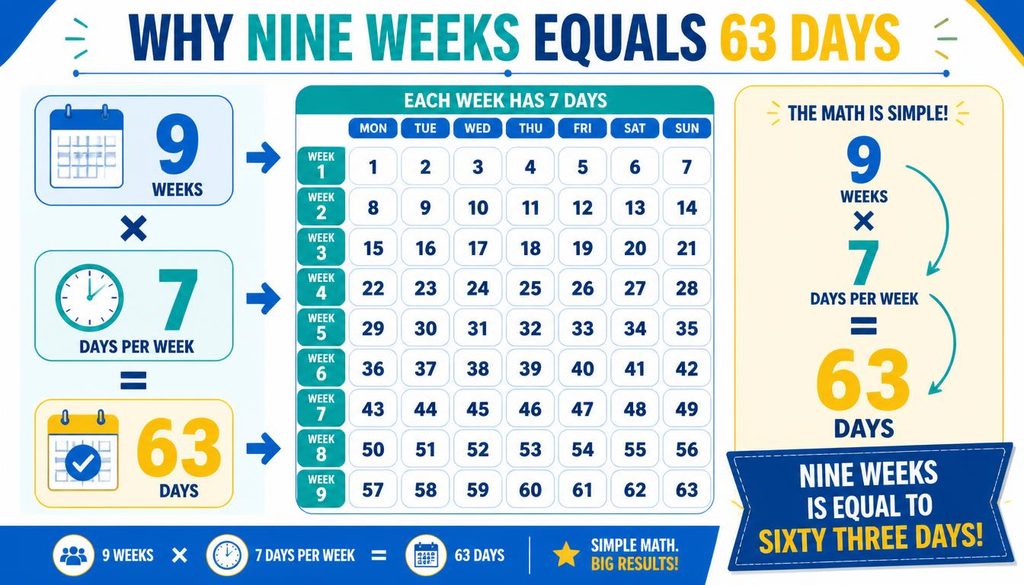
It may seem obvious that nine weeks equals 63 days, but understanding this conversion helps prevent errors when planning ahead. A week is always seven days in the Gregorian calendar, so multiplying the number of weeks by seven gives the total duration.
For example:
- 1 week equals 7 days.
- 2 weeks equal 14 days.
- 3 weeks equal 21 days.
- 4 weeks equal 28 days.
- 5 weeks equal 35 days.
- 6 weeks equal 42 days.
- 7 weeks equal 49 days.
- 8 weeks equal 56 days.
- 9 weeks equal 63 days.
- 10 weeks equal 70 days.
Nine weeks is also approximately two months and one week, although the exact calendar interval depends on which months are involved. Months have different lengths, so converting weeks into days is generally more reliable when you need an exact date.
For anyone searching for 63 days from today, the same calculation applies. Starting on October 18, 2026, and adding 63 days produces December 20, 2026.
What Day Will It Be in 9 Weeks?
The answer is Sunday. This is one of the useful features of calculating dates in complete weeks: the weekday stays the same.
If today is Monday, nine weeks later will also be Monday. If the starting date is Friday, the date nine weeks later will fall on Friday. Every full week contains the same seven-day cycle, so the weekday doesn’t change when you add a whole number of weeks.
For our example, October 18, 2026, falls on Sunday. Moving ahead by nine weeks brings us to Sunday, December 20, 2026.
This can be especially handy for recurring activities. Suppose you attend a class every Sunday and need to estimate a date nine weeks away. You can count nine Sundays on your calendar, but adding 63 days provides the same result without the extra effort.
The same principle works for work schedules, weekend trips, family events, and community activities. It’s a small calendar trick that saves a surprising amount of second-guessing.
Understanding December 20, 2026, on the Calendar
December 20, 2026, arrives near the end of the calendar year. It is a Sunday, and only a short stretch remains before January begins.
For many people, late December is a time for reflection and planning. Some are arranging holiday travel, others are completing work projects, and plenty of families are simply trying to find a day when everyone can sit together without rushing off somewhere else.
Here are a few useful facts about the date.
The Day of the Year
December 20 is the 354th day of 2026. Since 2026 is not a leap year and contains 365 days, this date falls relatively late in the annual calendar.
There are 11 calendar dates after December 20 before December 31 ends: December 21 through December 31. If you’re measuring the elapsed time until midnight at the beginning of January 1, 2027, there are 12 days.
The distinction matters because “days remaining in the year” can mean either the number of later dates within the year or the time left until the next year begins.
The Week of the Year
December 20 falls in the final part of the year. Under the common Sunday-start calendar convention that labels the week containing January 1 as the first week, it is in week 52.
However, week numbering isn’t universal. The ISO 8601 standard starts weeks on Monday and defines week one as the week containing January 4. Under ISO numbering, December 20, 2026, falls in week 51.
If you’re checking a week of the year for work, travel, or a report, it’s worth knowing which calendar convention your organization uses. Otherwise, two calendars might display different week numbers for the same date without either one being wrong.
Percentage of the Year Completed
December 20 is the 354th day of a 365-day year. Using the day number divided by the total number of days gives:
\[ \frac{354}{365}\times100 \approx 96.99\% \]
So, approximately 96.99% of the year’s calendar days have been reached by December 20 when the day number is used as the numerator. This is a day-position calculation rather than a precise measure of elapsed time during that date, which depends on the time of day.
By this point, the year is drawing to a close, and many people are already thinking about their plans for 2027.
How a Date Calculator Makes Things Easier
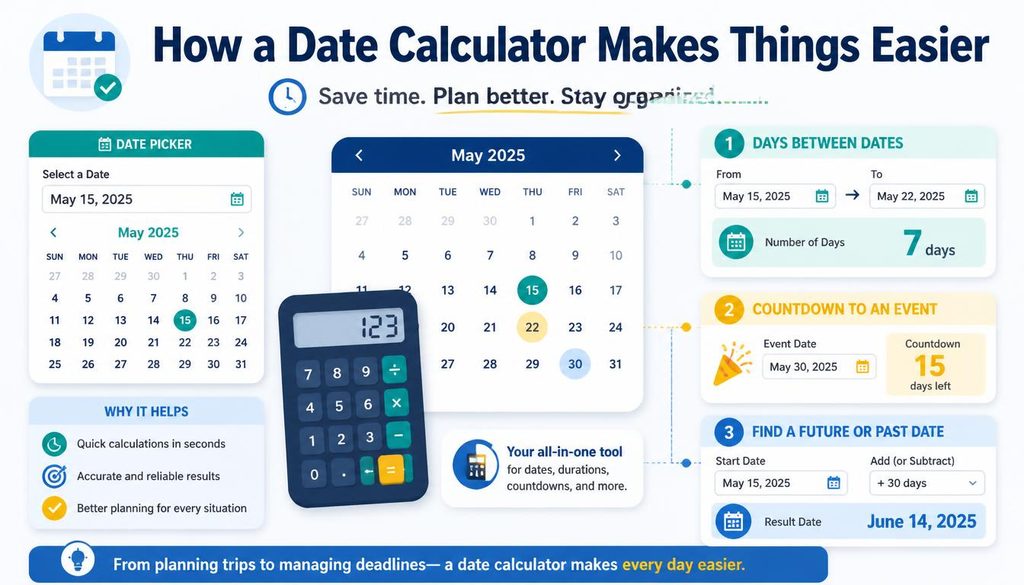
A Date Calculator can turn a simple question into an immediate answer. Instead of flipping through pages on a wall calendar, you enter a starting date, choose the interval, and let the tool calculate the result.
A good online date calculator may support several types of calculations, including adding weeks, subtracting days, finding dates in the past, and comparing calendar intervals.
Depending on the tool, you may also be able to calculate the day of the week or find how many days separate two dates.
Here are some of the most common reasons to use one.
Planning Appointments and Deadlines
Imagine that you’ve been given nine weeks to complete a school project, prepare a presentation, or finish a work assignment. Knowing the final date helps you divide the task into smaller stages rather than leaving everything until the last minute.
You could set an early research deadline, a halfway review, and a final completion date. A simple future date calculator makes those milestones easier to organize.
Organizing Family Events
Family gatherings often require coordination between people with different schedules. Calculating a date nine weeks ahead can give relatives enough time to arrange transport, request time off, or make other preparations.
The same approach works for birthdays, anniversaries, reunions, and community celebrations. The date itself may be a small piece of the plan, but getting it right helps everything else fall into place.
Tracking Personal Goals
Perhaps you want to develop a reading habit, learn a new skill, or work on a creative project. A nine-week period gives you a clear timeframe for making steady progress.
Instead of concentrating only on the final day, break the 63 days into weekly targets. That makes the goal feel more manageable, even when life gets a little unpredictable.
Calculating Dates in the Past
Some calculators work in both directions. A weeks ago from today calculation lets you find an earlier date by subtracting a certain number of weeks from your starting date.
For instance, you might need to review an event from nine weeks earlier, compare project records, or work out when a particular milestone occurred. A past-date calculation uses the same seven-day conversion, except that you move backward rather than forward.
Other Useful Date Calculations to Explore
Once you understand the nine-week interval, you can use the same technique for other periods. Each calculation begins with a reference date and adds or subtracts the required number of days.
For a starting date of October 18, 2026, the following future dates are useful examples.
| Time period | Total days | Future date |
|---|---|---|
| 3 weeks from today | 21 | November 8, 2026 |
| 4 weeks from today | 28 | November 15, 2026 |
| 5 weeks from today | 35 | November 22, 2026 |
| 6 weeks from today | 42 | November 29, 2026 |
| 7 weeks from today | 49 | December 6, 2026 |
| 8 weeks from today | 56 | December 13, 2026 |
| 9 weeks from today | 63 | December 20, 2026 |
| 10 weeks from today | 70 | December 27, 2026 |
| 12 weeks from today | 84 | January 10, 2027 |
These examples demonstrate how quickly a few additional weeks can move a date into another month or even another calendar year. They can also be useful internal-linking opportunities for a website that provides a collection of weeks from today calculators.
If you regularly plan ahead, you might explore a 3 weeks from today calculation for a short-term deadline, an 8 weeks from today calculation for a medium-term goal, or a 12 weeks from today calculation for a longer planning window.
How to Customize a Date Calculation Online
Not every date question starts with today’s date. Sometimes you need to calculate a future interval from a birthday, a meeting, or a date written in a document. In these situations, a customizable Date Calculation Tool is especially useful.
Follow these general steps:
- Choose your starting date. This may be today’s date or any other date you want to use.
- Select the direction of the calculation. Choose a future date or a past date.
- Enter the number of weeks. For this example, enter nine.
- Review the result. Check the full calendar date and weekday.
- Confirm the time interval. If you need an exact deadline, remember that the time of day and any relevant time zone may matter too.
A calendar date calculator can be particularly helpful if you work with different starting dates throughout the year. Some websites, including date-calculation services such as Timer.live, may offer related date and time tools; available features can vary.
Before relying on a result for a formal deadline, check the rules that apply to your situation. Business days, public holidays, and official filing periods do not always follow the same counting method as ordinary calendar days.
Common Mistakes When Calculating Nine Weeks Ahead
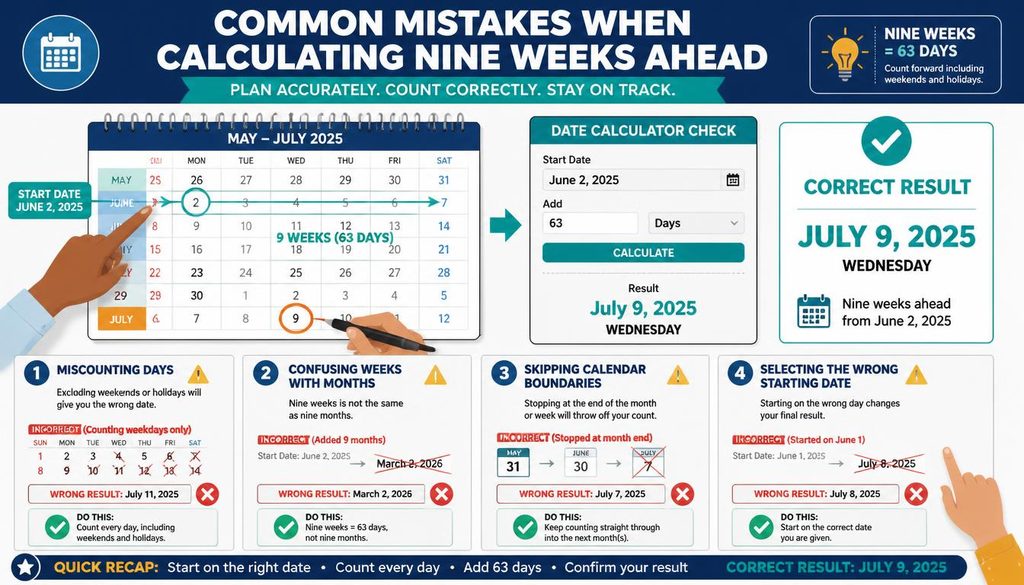
Even a simple date calculation can become confusing if the starting point isn’t clear. Most mistakes happen because people count the first day twice, mix up calendar days with business days, or assume every month contains the same number of days.
Counting the Starting Day as Day One
When you add 63 days to October 18, you move forward by 63 days. October 18 is the reference point, not the first completed day of the interval.
This is why adding 63 days gives December 20 rather than December 19. The distinction may sound tiny, but it can matter when you’re setting an appointment or recording a deadline.
Confusing Weeks With Months
Nine weeks is 63 days, but it is not always exactly two months and one week in every practical calendar comparison. Calendar months have 28, 29, 30, or 31 days, so month-based calculations can produce different results.
If the request specifically says nine weeks, use the 63-day interval rather than substituting a rough estimate in months.
Forgetting That Week Numbers Vary
Different calendars use different rules for identifying the first week of the year. An ISO calendar and a Sunday-start calendar can assign different week numbers to the same date.
If the week number is important, confirm the convention before using it in a report or schedule.
Using an Old Reference Date
A result calculated from October 18, 2026, remains correct for that starting date, but it will not be the right answer for someone starting the calculation on a later day.
Always verify the date you enter in your online weeks from today calculator. A correct calculation with an outdated starting date can still give you the wrong result for your needs.
Practical Ways to Make the Most of a 63-Day Period
Nine weeks is long enough to plan something meaningful but short enough to keep a clear end date in sight. Whether you’re organizing a project or preparing for a personal milestone, a little structure can help you use the time wisely.
One practical approach is to divide the interval into three stages. Use the first three weeks to plan and gather what you need, the middle three weeks to make steady progress, and the final three weeks to review your work and handle the remaining details.
For an event, this could mean confirming the venue first, arranging invitations and transport in the middle, and checking final details closer to the date. For a personal goal, it might mean learning the basics, practicing regularly, and then reviewing how far you’ve come.
It also helps to add reminders to a digital calendar. A reminder two weeks before the final date can give you a useful checkpoint, while another a few days ahead can prompt you to confirm any last details.
The aim isn’t to fill every day with tasks. It’s to make the future date useful, giving yourself enough direction to move forward without turning the entire nine weeks into one long countdown.
Frequently Asked Questions
what is 9 weeks from today
9 weeks from today is December 20, 2026. This is exactly 63 days after October 18, 2026.
9 weeks from now
9 weeks from now falls on December 20, 2026, which is a Sunday.
what day was it 9 weeks ago
9 weeks ago was Sunday, August 16, 2026, exactly 63 days before October 18, 2026.
what day was 9 weeks ago
The day 9 weeks ago was Sunday, August 16, 2026.
what was the date 9 weeks ago
The date 9 weeks ago was August 16, 2026, counting back 63 days from October 18, 2026.
Read This Blog:https://elvaronixy.com/date-calculator-5-weeks-from-today/
Conclusion
Working out 9 Weeks From Today is straightforward once you know the starting date and remember that nine weeks equals 63 days. With October 18, 2026, as the reference point, the calculation leads to Sunday, December 20, 2026, the 354th day of the year.
Whether you’re planning an appointment, organizing a family gathering, setting a personal goal, or simply curious about a future date, a little calendar knowledge can make planning much less stressful.
Use a Weeks Calculator when you need a quick answer, double-check the starting date, and keep track of any special deadline rules that might apply.
And remember, a future date is more than a number on a calendar. It can be the day you finish a project, meet someone important, celebrate a milestone, or finally put a long-awaited plan into action. Mark the date, make a practical plan, and give yourself something worthwhile to look forward to.