
Have you ever looked at your phone early in the morning and wondered what the clock would say after eight more hours?
Maybe you’re planning a work shift, waiting for an important phone call, arranging an online meeting, or simply trying to figure out when you’ll finally have some free time. It’s a small question, but getting the answer right can make your day a little easier.
Knowing 8 Hours From Now is more than just adding a number to a clock. It helps you plan appointments, organize daily activities, manage deadlines, and understand how time moves from one part of the day to another. Sometimes, even a simple calculation can save you from missing something important.
The good news is that calculating a future time is quite easy once you understand the basic rule. You can do it mentally, use your phone’s clock, or try an online time calculator when you need an exact answer.
Let’s explore the calculation, useful examples, time conversions, and practical ways to use this information in everyday life.
| Hours From Now | Result |
|---|---|
| 1 hour | Current time + 1 hour |
| 2 hours | Current time + 2 hours |
| 4 hours | Current time + 4 hours |
| 6 hours | Current time + 6 hours |
| 8 hours | Current time + 8 hours |
What Time Is 8 Hours From Now?
The answer depends on your current time and time zone. Eight hours added to an early morning time will usually lead to the afternoon, while eight hours added to an afternoon time may take you into the evening or the next day.
For a specific example, suppose the starting time is Monday, October 19, 2026, at 5:24:20 AM Pacific Time. Adding eight hours gives you 1:24:20 PM on Monday, October 19, 2026. The date remains the same because the calculation doesn’t cross midnight.
Here is a quick look at the example:
Starting time
5:24:20 AM
Monday, October 19, 2026 · Pacific Time
Time added
8 hours
480 minutes or 28,800 seconds
Calculated future time
1:24:20 PM
Monday, October 19, 2026
This is an illustrative calculation using the stated starting time, not a universal answer for every reader. Your result will differ if your local clock shows a different time.
For example, if it is 7:00 AM where you live, eight hours later it will be 3:00 PM. If it’s 10:30 AM, the answer is 6:30 PM. The clock simply moves forward by eight complete hours, and the minutes and seconds remain unchanged when you add whole hours.
How to Calculate 8 Hours From Now
Calculating 8 hours from now doesn’t require any complicated mathematics. You only need to know the starting time and move the clock forward by eight hours. Sounds simple, and honestly, it is once you get the hang of it.
The basic formula is:
\[ \text{Future Time}=\text{Current Time}+8\text{ hours} \]
Follow these steps to find the answer:
- Check the current time: Look at your phone, computer, watch, or another reliable clock.
- Add eight to the hour: If the clock reads 6:00 AM, adding eight hours gives 2:00 PM.
- Keep the minutes unchanged: If your starting time is 6:35 AM, your future time will be 2:35 PM.
- Check whether the date changes: If adding eight hours takes you past midnight, the result belongs to the following calendar day.
Let’s take another example. Suppose you begin studying at 9:15 AM and want to know what time it will be after eight hours. Adding eight to nine gives seventeen in 24-hour notation, which is 5:15 PM in the 12-hour clock system. That’s your answer, no calculator needed.
One little detail worth remembering is that adding eight hours does not mean the clock will always show PM. The starting time determines the result, so late-night calculations may end in the early morning instead.
How Much Time Is Eight Hours From Now?
Eight hours can feel surprisingly short or very long, depending on what you’re doing. A busy workday might seem to disappear in a blink, while waiting for a special event can make each minute feel unusually slow.
In mathematical terms, an eight-hour duration always represents the same amount of elapsed time. Here are the main conversions to remember.
| Measurement | Equivalent |
|---|---|
| Hours | 8 |
| Minutes | 480 |
| Seconds | 28,800 |
| Milliseconds | 28,800,000 |
These conversions are useful for schedules, digital timers, programming tasks, and everyday planning. For instance, someone setting an eight-hour timer for a project can use the same duration whether the clock starts at sunrise or late in the evening.
An eight-hour period is also often associated with a standard work shift or a typical sleep opportunity. However, the actual time spent working or sleeping varies from person to person, and an eight-hour interval on the clock doesn’t automatically mean eight uninterrupted hours of activity.
How Many Minutes Are in 8 Hours?
There are 480 minutes in eight hours. To calculate this, multiply the number of hours by 60 because each hour contains 60 minutes.
\[ 8\times60=480\text{ minutes} \]
Imagine you’re planning a long journey and expect to leave at 7:20 AM. If you want to know when eight hours have passed, the answer is 3:20 PM. During that interval, 480 minutes will have elapsed.
This conversion is also helpful when you need to split your time into smaller blocks. You might divide an eight-hour study period into four sessions of two hours each, or organize a project into shorter working intervals with breaks in between.
Just remember that 480 minutes describes the total duration, not necessarily the amount of uninterrupted productive time you’ll have. Lunch, travel delays, breaks, and unexpected tasks can all affect your schedule.
How Many Seconds Are in 8 Hours?
Eight hours contains 28,800 seconds. Since every hour has 60 minutes and every minute has 60 seconds, you multiply eight by 60 twice.
\[ 8\times60\times60=28{,}800 \]
Seconds are particularly useful when you’re working with countdown timers, sports events, technical systems, or applications that measure elapsed time very precisely.
For example, a developer might need to set a process to run after a specific interval. Converting eight hours into 28,800 seconds provides a straightforward numerical value for systems that accept durations in seconds.
For everyday planning, you probably won’t need to count every second. Still, understanding the conversion makes it easier to see how hours, minutes, and seconds relate to one another.
How Many Milliseconds Are in 8 Hours?
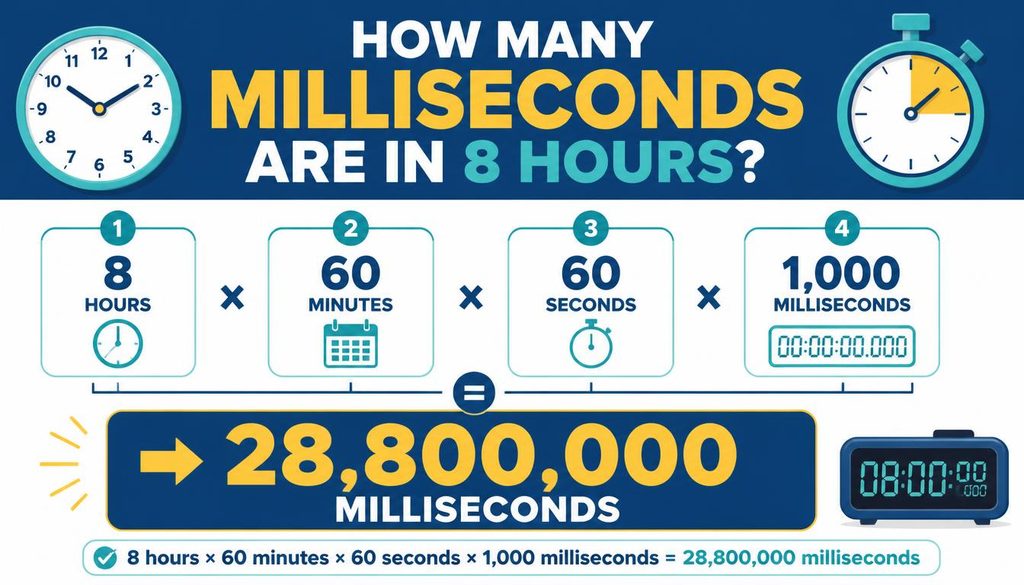
A millisecond is one-thousandth of a second. Although we rarely think about such tiny intervals when planning an ordinary day, milliseconds are important in computing, digital clocks, and technical measurements.
To convert eight hours into milliseconds, multiply the duration by 3,600,000, the number of milliseconds in one hour.
\[ 8\times3{,}600{,}000=28{,}800{,}000 \]
Therefore, eight hours equals 28,800,000 milliseconds.
This value may be useful when setting delays in software, configuring digital systems, or comparing time measurements in different units. A normal appointment reminder doesn’t need this much precision, of course, but technical applications often do.
The important thing is to select the correct unit for your task. Hours work well for schedules, minutes are convenient for daily activities, and seconds or milliseconds can be more suitable for technical calculations.
How Does an Online Time Calculator Work?
An online time calculator makes future-time calculations quicker by doing the arithmetic for you. Rather than moving the clock forward manually, you enter a starting time and select the number of hours to add.
Some tools also let you subtract time, include minutes, change dates, or calculate durations between two different clock readings. This can be useful when you’re managing a busy schedule and don’t want to work everything out in your head.
A typical Time Calculator follows a simple process:
- Enter your starting time.
- Select the number of hours you want to add.
- Include any additional minutes or seconds if needed.
- Choose the appropriate date or time zone if the tool supports those options.
- Read the calculated result and verify the date.
Websites such as timer.live may be useful starting points for people looking for online timing tools. Available features can vary, so check whether a particular calculator supports your intended calculation before relying on it.
A time difference calculator is another useful option when you know two clock readings and want to find the elapsed duration between them. That is a slightly different task from adding eight hours to the present moment, although both involve time arithmetic.
Can You Customize Your Time Calculation?
Yes, you can adjust a time calculation to match your plans. Eight hours is only one possible interval, and sometimes you may need to add several hours and a few extra minutes instead.
Suppose you have a meeting scheduled 8 hours and 45 minutes after your starting time. First, add eight hours, then move forward another 45 minutes. This two-step method works well even when the calculation crosses into a new day.
You can also use a future time calculator to explore other intervals, such as five, ten, or twenty-four hours from a given starting point.
Here are some related calculations you might find useful:
| Time interval | What it helps you calculate |
|---|---|
| 5 hours from now | A shorter upcoming interval |
| 6 hours from now | A later part of the same day |
| 7 hours from now | An approaching appointment or deadline |
| 8 hours from now | The main calculation in this guide |
| 9 hours from now | A longer daytime or overnight interval |
| 10 hours from now | A future event later in the day |
| 12 hours from now | The opposite half of the daily clock cycle |
| 24 hours from now | Approximately the same local clock time tomorrow |
These intervals are handy for planning reminders, arranging calls, and tracking deadlines. If you’re comparing several possible starting times, writing down each result can prevent confusion, especially when some calculations cross midnight.
Understanding AM and PM When Adding Eight Hours
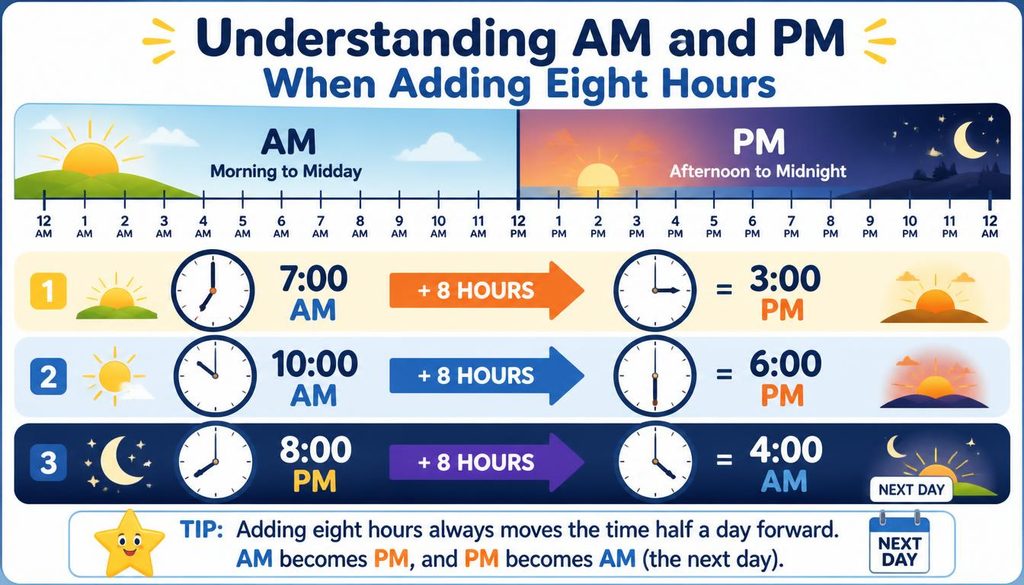
The 12-hour clock divides a day into two periods: AM and PM. AM generally covers midnight through the morning up to noon, while PM covers noon through the evening up to midnight.
When calculating 8 hours later, pay attention to the transition between these periods. A calculation that starts in the morning may finish in the afternoon, while one that starts in the evening may finish the next morning.
Consider these examples:
| Starting time | Eight hours later |
|---|---|
| 2:00 AM | 10:00 AM |
| 5:30 AM | 1:30 PM |
| 8:15 AM | 4:15 PM |
| 11:00 AM | 7:00 PM |
| 2:45 PM | 10:45 PM |
| 6:00 PM | 2:00 AM the next day |
| 10:30 PM | 6:30 AM the next day |
The main thing to remember is that adding eight hours changes the hour, not the minute value. The AM or PM label changes whenever the result crosses noon or midnight.
If you use a digital clock that displays 24-hour time, these transitions can be easier to track because the hours run from 00 to 23. For instance, 1:00 PM becomes 13:00, and 8:00 PM becomes 20:00.
What Is the Difference Between 8 Hours From Now and 8 Hours Ago?
These phrases sound similar, but they point in opposite directions on the timeline.
8 hours from now means moving forward from the current moment. 8 hours ago means moving backward by the same duration.
Imagine that your current time is 1:00 PM. Eight hours from now is 9:00 PM, whereas eight hours ago was 5:00 AM on the same day.
The difference becomes more noticeable when your starting time is close to midnight. If it is 3:00 AM, eight hours ago was 7:00 PM on the previous calendar day, while eight hours from now is 11:00 AM today.
This distinction matters when checking message timestamps, reviewing work records, organizing travel schedules, or calculating when an event happened. Mixing up past and future calculations can lead to mistakes, even when the arithmetic itself is correct.
For more detailed planning, you can compare related searches such as 8 hours ago, 10 hours from now, 12 hours from now, or 24 hours from now. Each calculation uses the same basic method, just with a different duration or direction.
How Time Zones Affect the Calculation
Your time zone matters whenever you coordinate with someone in another region or use a clock set to a different location. Adding eight hours to a local starting time gives you the local clock reading eight hours later, provided you account for any clock changes that occur during the interval.
For example, the source calculation in this article uses Pacific Time, beginning at 5:24:20 AM on October 19, 2026, and ending at 1:24:20 PM on the same date. Someone using Pakistan Standard Time will see a different local clock reading for the same instant.
If you’re scheduling an international meeting, make sure you distinguish between elapsed time and time zone conversion. They are related, but not identical.
A reliable time-zone converter can help you compare locations. Be particularly careful around daylight-saving transitions, because some regions change their clocks during the year.
Pakistan Standard Time does not observe daylight saving time in 2026, while Pacific Time does, so the difference between those locations depends on the date.
Practical Ways to Use an Eight-Hour Time Calculation
Knowing the future time can help with far more than answering a quick question. Once you start noticing how often time calculations appear in daily life, you’ll find plenty of situations where this simple skill is useful.
Work and study schedules
If your work shift begins at 8:00 AM and lasts eight hours, the end time is 4:00 PM, assuming the stated shift duration includes the entire interval. If your workplace provides an unpaid lunch break outside those hours, your actual finishing time may be later.
Students can use the same calculation to plan study sessions, revision periods, or assignment milestones. A clear schedule makes it easier to balance work with breaks and other responsibilities.
Travel planning
An eight-hour journey can take you from early morning into the afternoon or from evening into the following morning. Check the estimated travel duration alongside departure times, stops, and the time zone of your destination.
Reminders and appointments
If someone asks you to contact them eight hours after a particular time, calculate the result and set a reminder on your phone. This is often more reliable than trying to remember the time while handling several other tasks.
Cooking and household routines
Some recipes, food-preparation schedules, and household tasks involve waiting periods measured in hours. Calculate the expected finish time and use a timer or reminder where appropriate. Always follow the specific safety and storage instructions for the task rather than relying on elapsed time alone.
Personal planning
Maybe you’re organizing a family event, planning a video call, or setting aside time for a hobby. Adding eight hours helps you see where an activity fits into your day, leaving less room for last-minute surprises.
Frequently Asked Questions
8 hours from now is what time
Eight hours from now is the current time plus 8 hours. The exact result depends on your current local time.
what is 8 hours from now
To find the time 8 hours from now, add 8 hours to the present time. If the calculation passes midnight, the result will be on the next day.
what time is it in 8 hours
The time in 8 hours can be calculated by moving forward 8 hours on the clock. Remember to account for AM or PM when determining the result.
what time is 8 hours from now
Add 8 hours to your current local time to find the future time. This simple calculation works for both morning and evening hours.
eight hours from now
Eight hours from now means the time exactly 8 hours after the present moment. Depending on the starting time, it may fall on the same day or the following day.
Read This Blog:https://elvaronixy.com/date-calculator-9-weeks-from-today/
Conclusion
Calculating 8 Hours From Now is a simple skill that can make everyday planning more manageable.
Whether you’re organizing a work shift, setting a reminder, arranging a call, or figuring out when a task will finish, the basic rule remains the same: add eight hours to your starting time and check whether the date changes.
Remember the essential conversions too: eight hours equals 480 minutes, 28,800 seconds, and 28,800,000 milliseconds. With those values in mind, you can handle most ordinary time calculations without much effort.
For a more accurate result, always begin with the correct current time and account for your local time zone. An online calculator can help when you need extra precision, but the basic arithmetic is easy enough to do yourself.
Time keeps moving whether we’re watching the clock or not, so a little preparation can make the day feel more organized.
If you have a useful trick for calculating future times, or a personal example where knowing the exact time helped you, share it in the comments. Your tip might make someone else’s planning a bit easier.